Key Takeaways
- Gout is an inflammatory arthritis caused by monosodium urate crystals, not simply a dietary problem.[1]
- For a flare, low-dose colchicine, an NSAID, or oral corticosteroids are first-line choices, selected for the person’s comorbidities and medicines.[1]
- Allopurinol is the preferred first urate-lowering medicine, with a usual serum urate target below 6 mg/dL.[1]
- Joint-fluid crystal analysis is the diagnostic reference standard when a first or atypical hot swollen joint could be infection.[14]
- Meat, seafood, beer, spirits, and sugar-sweetened soda are associated with higher gout risk, while dairy and a DASH-style pattern are favorable.[9][15][18]
- Fever, severe illness, rapidly spreading redness, or a first hot swollen joint requires urgent in-person assessment to exclude septic arthritis.[22]
What Is Gout?
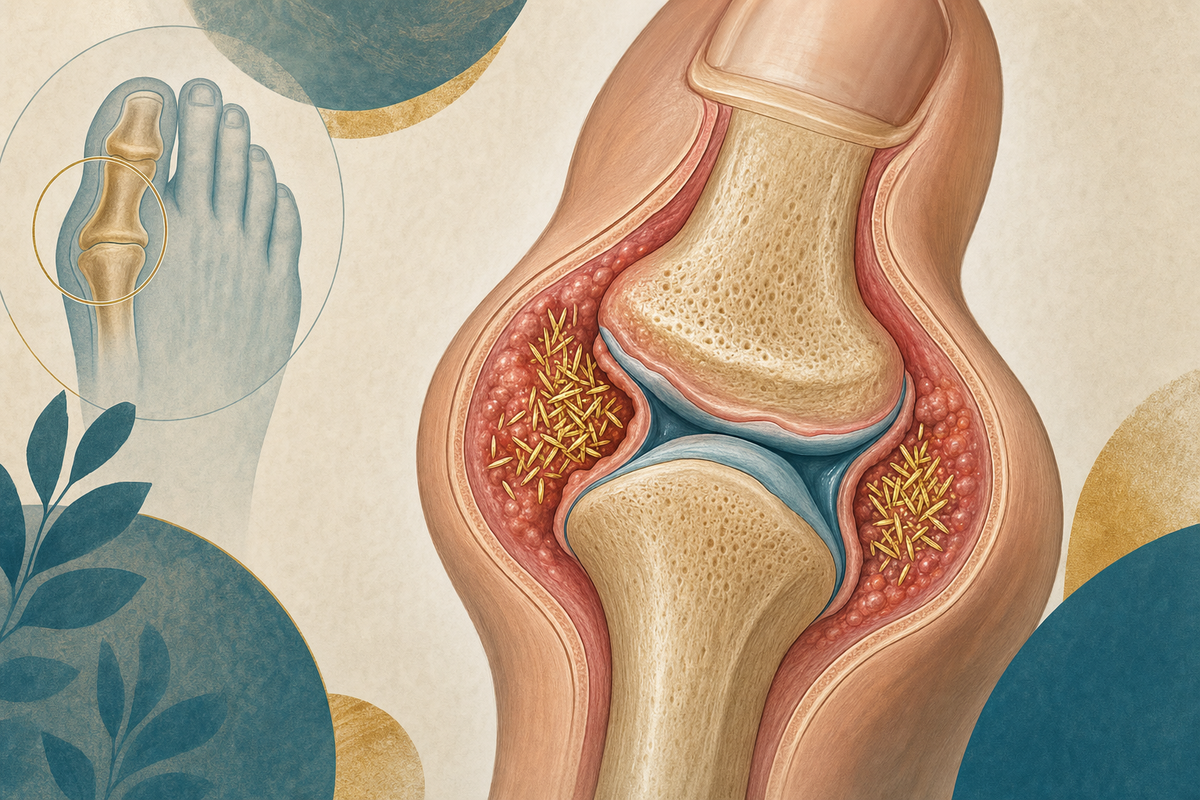
Gout is a chronic inflammatory arthritis. It develops when monosodium urate crystals form in and around joints after urate has been elevated long enough to become supersaturated. The immune response to those crystals causes sudden, severe attacks and, without adequate urate control, can lead to tophi and structural joint damage.[1] Gout affected about 3.9% of U.S. adults, or roughly 9.2 million people, in 2015 to 2016 NHANES data.[13]
A painful big-toe attack is called podagra, but gout can affect the midfoot, ankle, knee, wrist, elbow, or more than one joint. A serum urate level above its solubility threshold supports the biology, but a blood test alone neither proves nor excludes gout.[22]
Symptoms of a Gout Attack
A classic attack begins abruptly, often overnight, with intense pain that peaks quickly. The joint can become swollen, warm, red, and exquisitely tender. Even the pressure of a sheet may hurt. Symptoms often improve over days, but a hot, painful joint is not automatically gout. Infection can look similar and must be considered, especially with fever or systemic illness.[14]
Important: A first-ever hot, swollen joint deserves an in-person assessment. Joint aspiration can identify crystals and rule out septic arthritis.
How Long Does a Gout Attack Last?
An untreated flare typically builds to a severe peak within the first 12 to 24 hours, often beginning overnight, and then settles gradually over about one to two weeks.[1] Treatment started early, ideally within the first 24 hours, shortens both the peak and the tail. The clearest trial signal comes from the AGREE study, in which low-dose colchicine taken at the first sign produced meaningful pain reduction within the first day.[2]
The timing matters in two practical ways. First, starting an anti-inflammatory within the first day is the single most reliable way to blunt an attack, so people who know they have gout should treat at the first twinge rather than waiting to see how bad it gets. Second, a flare is not a reason to stop or start long-term urate-lowering therapy blindly: if allopurinol or febuxostat is already on board, it should be continued through the attack while the flare itself is treated separately.[1] For a step-by-step guide to the first-line options, dosing, and home measures, see our gout attack treatment guide.
What Causes Gout: Hyperuricemia and Triggers
Urate is the end product of purine metabolism. In most people with gout, the kidneys do not eliminate enough urate. Genetics, kidney function, obesity, insulin resistance, alcohol, dehydration, rapid weight change, certain foods, and medicines such as thiazide diuretics can all contribute. Diet matters, but it is only one piece of a broader metabolic and renal picture.[10][19]
Common short-term triggers include a recent alcohol binge, a large purine-rich meal, illness, surgery, dehydration, and a sudden change in urate level after starting or stopping therapy. The goal is not to blame a single meal, but to reduce crystal burden and identify modifiable patterns.
Uric Acid Levels: What the Numbers Mean
Serum urate is reported in milligrams per deciliter (mg/dL). The saturation point of urate in body fluids at normal body temperature is about 6.8 mg/dL, above which monosodium urate can form crystals. Typical laboratory reference ranges vary and often run higher in men than women, which means a value that reads "normal" on a lab report can still sit above the crystallization threshold and well above the gout treatment target.[13]
Gout risk rises steeply as the number climbs, so an elevated urate is a risk marker even before it has ever caused a flare.[10] On urate-lowering therapy, the target is below 6 mg/dL, or below 5 mg/dL with tophi.[1] A single normal reading during an acute attack does not rule out gout, because urate often dips in the first days of a flare, so an uncertain reading is often repeated after the attack settles.[14] For the full breakdown of ranges, thresholds, and treatment targets, see our uric acid levels guide.
What's Changed in 2024 to 2026
The core management approach remains treat-to-target urate lowering, low starting doses, and anti-inflammatory prophylaxis when beginning urate-lowering therapy.[1] Evidence has also clarified several decisions: the FAST trial found febuxostat noninferior to allopurinol for its cardiovascular endpoint, while CARES found higher cardiovascular and all-cause mortality in people with established cardiovascular disease, so individual cardiovascular history still matters.[3][4]
For uncontrolled gout requiring pegloticase, adding methotrexate improved complete response at six months from 40% to 71% in the MIRROR trial.[7] In diabetes research, SGLT2 inhibitors have been associated with lower incident gout in patients with type 2 diabetes when compared with other glucose-lowering agents. These medicines are not prescribed solely as gout treatment.[11][20]
How Gout Is Diagnosed
Finding needle-shaped, negatively birefringent monosodium urate crystals in joint fluid is the reference standard. Aspiration is especially important for a first presentation, an unusual pattern, immune suppression, fever, or concern for infection. The 2015 ACR/EULAR criteria can support classification when crystal confirmation is unavailable.[22]
Ultrasound may show a double-contour sign, and dual-energy CT can identify urate deposits. In a systematic review, pooled diagnostic sensitivity and specificity for dual-energy CT were 0.87 and 0.84; results should be interpreted with the history and examination, not in isolation.[14]
Treating an Acute Gout Flare: Three First-Line Options
For a complete walkthrough of the first-line medicines, dosing, home measures, and when to seek urgent care, see our dedicated gout attack treatment guide, and read how colchicine differs from allopurinol in allopurinol vs colchicine.
Start treatment as soon as practical after symptoms begin. The ACR lists low-dose colchicine, NSAIDs, and glucocorticoids as first-line choices, with selection guided by kidney disease, ulcer or bleeding history, cardiovascular risk, diabetes, drug interactions, and prior response.[1] The AGREE trial found that the modern low-dose colchicine regimen, 1.2 mg followed by 0.6 mg one hour later, provided similar 24-hour response to the older high-dose approach with fewer gastrointestinal effects.[2]
Rest, ice, elevation, hydration, and avoiding alcohol can support medication treatment. Do not stop established allopurinol or febuxostat during a flare unless a clinician advises it.
Medication Comparison Table
| Option | Typical acute approach | Often avoided or adjusted when | Useful fit |
|---|---|---|---|
| Low-dose colchicine | 1.2 mg, then 0.6 mg one hour later | Major kidney or liver impairment, or interacting CYP3A4/P-gp medicines | Very early flare, NSAID risk |
| NSAID | Full anti-inflammatory dose, then step down as flare settles | Kidney disease, ulcer or GI bleeding risk, anticoagulation, uncontrolled heart failure | Otherwise healthy adult with prior NSAID tolerance |
| Oral corticosteroid | Often prednisone 30 to 40 mg daily for a short course, individualized | Poorly controlled diabetes, active infection, some psychiatric or bone risks | NSAID or colchicine unsuitable |
Colchicine has important interaction and dose-adjustment issues. Strong CYP3A4 or P-gp inhibitors can create dangerous colchicine exposure, especially with renal or hepatic impairment.[12]
Long-Term Urate-Lowering Therapy: Who Needs It and How to Titrate
Urate-lowering therapy is strongly recommended for people with one or more tophi, gout-related radiographic damage, or frequent flares, defined as two or more yearly. Allopurinol is preferred first-line, including for many people with chronic kidney disease. Start low, commonly 100 mg daily or lower with impaired kidney function, then titrate using serial serum urate measurements to a target below 6 mg/dL.[1]
Starting ULT during a flare can be considered when anti-inflammatory treatment is also provided. A randomized trial by Taylor and Mecchella found no meaningful difference between immediate and delayed allopurinol initiation in the acute setting, and the ACR guideline conditionally supports starting when indicated.[24]
Allopurinol vs Febuxostat vs Probenecid vs Pegloticase
| Agent | Role | Key considerations |
|---|---|---|
| Allopurinol | Preferred first-line xanthine oxidase inhibitor | Start low, titrate to target. Consider HLA-B*58:01 testing in higher-risk ancestry groups. |
| Febuxostat | Alternative xanthine oxidase inhibitor | Review cardiovascular history and the U.S. boxed warning. |
| Probenecid | Uricosuric option | Less useful with reduced kidney function; requires adherence and hydration. |
| Pegloticase | IV therapy for uncontrolled, refractory gout | Specialist infusion treatment; methotrexate co-therapy can improve sustained response. |
Pegloticase is reserved for severe disease that has not responded to conventional ULT. In pivotal trials, 42% of people receiving it every two weeks maintained urate below 6 mg/dL through months three and six, compared with 0% on placebo.[6] Febuxostat labeling carries a boxed warning in the U.S. after CARES, even though FAST reported a different cardiovascular result.[25]
HLA-B*58:01 Screening and Serious Skin Reactions
Allopurinol hypersensitivity syndrome, Stevens-Johnson syndrome, and toxic epidermal necrolysis are rare but potentially fatal. The HLA-B*58:01 allele is strongly associated with these reactions. The ACR conditionally recommends testing before allopurinol for people of Southeast Asian descent, including Han Chinese, Korean, and Thai ancestry, and for African American patients.[1] In the original association study, all 51 affected patients carried the allele, compared with 15% of tolerant controls.[5]
Stop allopurinol and seek immediate medical care for a new widespread rash, blistering, mouth sores, eye irritation, facial swelling, fever, or skin pain.
Diet and Lifestyle: What the Evidence Actually Shows
For the full, food-by-food list of what to avoid and what to eat, see our gout diet: foods to avoid guide.
Diet supports medical treatment, but it rarely replaces treat-to-target ULT for people who meet guideline criteria. Focus on repeatable changes, not punitive restriction. In a prospective study, the highest meat intake was associated with a relative risk of 1.41 for gout and the highest seafood intake with a relative risk of 1.51. Higher dairy intake was associated with a relative risk of 0.56, while even high-purine vegetables were not associated with gout risk.[15]
| Food group | Illustrative purine content, mg per 100 g | Practical gout message |
|---|---|---|
| Organ meats | 200 to 500 | Limit or avoid |
| Anchovies, sardines, mussels | 280 to 411 | Limit, particularly if a personal trigger |
| Beef, chicken, salmon, tuna | 133 to 257 | Moderate portions, emphasize overall pattern |
| Mushrooms, peas, spinach | 57 to 92 | Do not eliminate solely for gout |
| Tofu, milk, yogurt | 0 to 68 | Plant proteins and low-fat dairy can fit well |
Cherries: In a case-crossover study of 633 people with gout, cherry intake over the prior two days was associated with 35% lower odds of a recurrent attack, odds ratio 0.65. This is promising observational evidence, not proof that cherries replace medication.[8] Fructose: Men drinking two or more sugar-sweetened sodas daily had a relative risk of 1.85 versus less than one monthly; diet soda was not associated with gout in that study.[9]
Alcohol: Beer was associated with a relative risk of 2.51 per 12-ounce serving daily and spirits with 1.60, while wine up to two glasses daily was not associated with increased risk in one prospective cohort.[16] Coffee and DASH: Four or more cups of coffee daily was associated with a relative risk of 0.60, and the highest DASH adherence was associated with a hazard ratio of 0.68 for incident gout. These associations support a whole-diet approach, not a prescription to start coffee.[17][18]
For someone who also needs blood-pressure treatment, medication choice belongs to a clinician. In a large observational study, losartan was associated with lower incident gout risk, relative risk 0.81, while diuretics were associated with higher risk, relative risk 2.36.[19]
Diet myth check: Apple cider vinegar, baking soda, and celery seed lack reliable clinical evidence for treating gout. Tart cherry mega-doses have thin evidence beyond ordinary food servings, roughly a cup per day. Vitamin C mega-doses are not an answer either: 500 mg daily lowered serum urate by only 0.014 mg/dL in a randomized trial.[21]
Gout and Cardiovascular or Metabolic Comorbidities
Gout commonly travels with chronic kidney disease, hypertension, obesity, diabetes, and cardiovascular disease. These conditions affect medication selection and make regular urate monitoring more important. Cardiovascular decisions around febuxostat require particular care because the CARES and FAST trial populations and results differed.[3][4]
Colchicine is also being studied and used in selected cardiovascular settings. In COLCOT, low-dose colchicine reduced ischemic cardiovascular events after myocardial infarction, but that does not make it a substitute for standard gout or cardiac care.[23]
Gout vs Other Joint Conditions
For a side-by-side comparison focused specifically on calcium pyrophosphate disease, see our gout vs pseudogout guide.
Pseudogout, or calcium pyrophosphate deposition disease, can mimic gout but involves different crystals. Septic arthritis can cause a similar hot, swollen joint and can rapidly damage cartilage. Cellulitis affects the skin and soft tissue rather than the joint, while rheumatoid arthritis more often causes persistent, symmetric inflammatory joint symptoms. When the presentation is new, severe, atypical, or accompanied by fever, aspiration and culture are more useful than guesswork.[14]
Decision Framework: Home Care, Telehealth, or ER
Home measures can complement treatment for a familiar, mild flare while waiting for clinician guidance. A synchronous video visit can be appropriate for a recurrent flare in a patient with an established gout diagnosis and no warning signs, as well as for ULT initiation or titration, HLA-B*58:01 test ordering, diet counseling, follow-up urate monitoring, and medication interaction review. Prescribing allopurinol, febuxostat, colchicine, NSAIDs, and prednisone by synchronous video visit is legal in all 50 U.S. states because these are not controlled substances; local clinical judgment and state licensure still apply.[1]
| Situation | Appropriate setting | Why |
|---|---|---|
| Known recurrent flare, no fever or new red flags | Telehealth can be appropriate | History, visual exam, interaction review, and first-line prescriptions can often be handled by video. |
| ULT initiation, dose titration, HLA-B*58:01 order, diet counseling, urate follow-up | Telehealth can be appropriate | Requires history, lab coordination, and shared decision-making. |
| First-ever suspected gout or unclear diagnosis | In-person | Joint aspiration may be needed to identify crystals and exclude infection. |
| Tophi needing debridement, ultrasound or dual-energy CT, refractory disease needing pegloticase infusion | In-person specialist care | Procedures, imaging, and infusion monitoring require onsite services. |
| Fever, severe systemic symptoms, rapidly spreading redness, or inability to bear weight | Urgent in-person or ER evaluation | Septic arthritis and other serious diagnoses must be excluded promptly. |
Telehealth is a setting, not a diagnosis. A video visit should escalate to in-person care whenever the clinician cannot confidently distinguish a familiar flare from infection or another acute joint condition.
Red Flags: When Gout Needs Emergent Care
Seek same-day emergency or urgent evaluation for fever or chills with a hot joint, confusion or severe weakness, rapidly spreading redness, a wound near the joint, inability to bear weight, severe immune suppression, or a new blistering rash after allopurinol. These signs can indicate septic arthritis, serious infection, or a severe drug reaction rather than an uncomplicated flare.[5][14]
Frequently Asked Questions
A flare can settle even without treatment, but untreated urate crystal deposition can lead to recurrent flares, tophi, and joint damage. Treating the flare and, when indicated, lowering urate addresses different parts of the disease.[1]
No. If you already take allopurinol or febuxostat, continue it during a flare unless a clinician tells you otherwise. Treat the flare separately with an appropriate anti-inflammatory medicine.[1]
No. Serum urate can be normal during an acute flare. When the diagnosis is uncertain, finding monosodium urate crystals in joint fluid is the reference test.[14]
The best first choice depends on timing, kidney function, ulcer or bleeding risk, cardiovascular history, drug interactions, and diabetes. Low-dose colchicine, an NSAID, and oral corticosteroids are all first-line options.[1]
The ACR strongly recommends urate-lowering therapy for people with tophi, gout-related radiographic damage, or frequent flares, defined as two or more per year.[1]
No. Cherry intake was associated with fewer recurrent flares in an observational study, but it does not replace treat-to-target urate lowering when that therapy is indicated.[8]
No. High-purine vegetables were not associated with incident gout in a large prospective study. Overall dietary pattern matters more than eliminating vegetables.[15]
Yes. Beer and spirits were associated with higher gout risk in prospective data. Avoiding alcohol during and soon after a flare is a practical precaution.[16]
For most people receiving urate-lowering therapy, the target is below 6 mg/dL. A lower target below 5 mg/dL is commonly used in severe tophaceous disease.[1]
Allopurinol is preferred first-line. Febuxostat remains an option when allopurinol is not tolerated or not effective, but cardiovascular history should be reviewed because CARES and FAST produced different cardiovascular findings.[3]
For a patient with recurrent, previously diagnosed gout and no warning signs, a synchronous video visit can be appropriate for flare treatment, medication review, or urate monitoring. A first hot swollen joint or systemic illness needs in-person evaluation.[1]
Seek emergency evaluation for fever or chills with a hot swollen joint, rapidly spreading redness, inability to bear weight, severe illness, immune suppression, or concern for septic arthritis.[14]
References
- FitzGerald JD, Dalbeth N, Mikuls T, et al. 2020 American College of Rheumatology Guideline for the Management of Gout. Arthritis Care & Research. 2020;72(6):744-760. doi:10.1002/acr.24180. https://pmc.ncbi.nlm.nih.gov/articles/PMC10563586/
- Terkeltaub RA, Furst DE, Bennett K, Kook KA, Crockett RS, Davis MW. High versus low dosing of oral colchicine for early acute gout flare. Arthritis & Rheumatism. 2010;62(4):1060-1068. doi:10.1002/art.27327. PMID: 20131255. https://pubmed.ncbi.nlm.nih.gov/20131255/
- White WB, Saag KG, Becker MA, et al. Cardiovascular Safety of Febuxostat or Allopurinol in Patients with Gout. New England Journal of Medicine. 2018;378(13):1200-1210. doi:10.1056/NEJMoa1710895. PMID: 29527974. https://pubmed.ncbi.nlm.nih.gov/29527974/
- Mackenzie IS, Ford I, Nuki G, et al. Long-term cardiovascular safety of febuxostat compared with allopurinol in patients with gout (FAST). The Lancet. 2020;396(10264):1745-1757. doi:10.1016/S0140-6736(20)32234-0. PMID: 33181081. https://pubmed.ncbi.nlm.nih.gov/33181081/
- Hung SI, Chung WH, Liou LB, et al. HLA-B*5801 allele as a genetic marker for severe cutaneous adverse reactions caused by allopurinol. Proceedings of the National Academy of Sciences USA. 2005;102(11):4134-4139. doi:10.1073/pnas.0409500102. PMID: 15743917. https://pubmed.ncbi.nlm.nih.gov/15743917/
- Sundy JS, Baraf HSB, Yood RA, et al. Efficacy and Tolerability of Pegloticase for the Treatment of Chronic Gout in Patients Refractory to Conventional Treatment. JAMA. 2011;306(7):711-720. doi:10.1001/jama.2011.1169. PMID: 21846852. https://pubmed.ncbi.nlm.nih.gov/21846852/
- Botson JK, Saag K, Peterson J, et al. Methotrexate to Increase Response Rates in Patients With Uncontrolled Gout Receiving Pegloticase: 12-Month Findings. ACR Open Rheumatology. 2023;5(8):407-418. doi:10.1002/acr2.11578. PMID: 37385296. https://pubmed.ncbi.nlm.nih.gov/37385296/
- Zhang Y, Neogi T, Chen C, Chaisson C, Hunter DJ, Choi HK. Cherry consumption and decreased risk of recurrent gout attacks. Arthritis & Rheumatism. 2012;64(12):4004-4011. doi:10.1002/art.34677. PMID: 23023818. https://pmc.ncbi.nlm.nih.gov/articles/PMC3510330/
- Choi HK, Curhan G. Soft drinks, fructose consumption, and the risk of gout in men. BMJ. 2008;336(7639):309-312. doi:10.1136/bmj.39449.819271.BE. PMID: 18244959. https://pubmed.ncbi.nlm.nih.gov/18244959/
- Kuo CF, Grainge MJ, Zhang W, Doherty M. Global epidemiology of gout: prevalence, incidence and risk factors. Nature Reviews Rheumatology. 2015;11(11):649-662. doi:10.1038/nrrheum.2015.91. PMID: 26150127. https://pubmed.ncbi.nlm.nih.gov/26150127/
- Preston FG, Anson M, Riley DR, Ibarburu GH, Henney A, Lip GYH, et al. SGLT2 Inhibitors, but Not GLP-1 Receptor Agonists, Reduce Incidence of Gout in People Living With Type 2 Diabetes Across the Therapeutic Spectrum. Clinical Therapeutics. 2024;46(11):836-842. doi:10.1016/j.clinthera.2024.06.021. PMID: 39068059. https://pubmed.ncbi.nlm.nih.gov/39068059/
- U.S. Food and Drug Administration. COLCRYS (colchicine) prescribing information. Updated 2024. https://dailymed.nlm.nih.gov/dailymed/drugInfo.cfm?setid=8a5edd42-f1e5-4a67-a802-e2c0f6d19023
- Chen-Xu M, Yokose C, Rai SK, Pillinger MH, Choi HK. Contemporary Prevalence of Gout and Hyperuricemia in the United States and Decadal Trends: NHANES 2007-2016. Arthritis & Rheumatology. 2019;71(6):991-999. doi:10.1002/art.40807. PMID: 30618180. https://pubmed.ncbi.nlm.nih.gov/30618180/
- Newberry SJ, FitzGerald JD, Motala A, et al. Diagnosis of Gout: A Systematic Review in Support of an American College of Physicians Clinical Practice Guideline. Annals of Internal Medicine. 2017;166(1):27-36. doi:10.7326/M16-0462. PMID: 27802505. https://pubmed.ncbi.nlm.nih.gov/27802505/
- Choi HK, Atkinson K, Karlson EW, Willett W, Curhan G. Purine-rich foods, dairy and protein intake, and the risk of gout in men. New England Journal of Medicine. 2004;350(11):1093-1103. doi:10.1056/NEJMoa035700. PMID: 15014182. https://pubmed.ncbi.nlm.nih.gov/15014182/
- Choi HK, Atkinson K, Karlson EW, Willett W, Curhan G. Alcohol intake and risk of incident gout in men: a prospective study. The Lancet. 2004;363(9417):1277-1281. doi:10.1016/S0140-6736(04)16000-5. PMID: 15094272. https://pubmed.ncbi.nlm.nih.gov/15094272/
- Choi HK, Willett W, Curhan G. Coffee consumption and risk of incident gout in men: a prospective study. Arthritis & Rheumatism. 2007;56(6):2049-2055. doi:10.1002/art.22712. PMID: 17530645. https://pubmed.ncbi.nlm.nih.gov/17530645/
- Rai SK, Fung TT, Lu N, Keller SF, Curhan GC, Choi HK. The Dietary Approaches to Stop Hypertension diet, Western diet, and risk of gout in men. BMJ. 2017;357:j1794. doi:10.1136/bmj.j1794. PMID: 28487277. https://pubmed.ncbi.nlm.nih.gov/28487277/
- Choi HK, Soriano LC, Zhang Y, Rodríguez LA. Antihypertensive drugs and risk of incident gout among patients with hypertension. BMJ. 2012;344:d8190. doi:10.1136/bmj.d8190. PMID: 22240117. https://pubmed.ncbi.nlm.nih.gov/22240117/
- Hatano M, Okada A, Sasabuchi Y, et al. Gout incidence in metformin versus sodium-glucose co-transporter-2 inhibitor users: a retrospective cohort study. Rheumatology (Oxford). 2025;64(7):3654-3661. PMID: 40127201. https://pubmed.ncbi.nlm.nih.gov/40127201/
- Stamp LK, O'Donnell JL, Frampton C, Drake JM, Zhang M, Chapman PT. Clinically insignificant effect of supplemental vitamin C on serum urate in patients with gout: a pilot randomized controlled trial. Arthritis & Rheumatism. 2013;65(6):1636-1642. doi:10.1002/art.37925. PMID: 23681955. https://pubmed.ncbi.nlm.nih.gov/23681955/
- Neogi T, Jansen TL, Dalbeth N, et al. 2015 Gout Classification Criteria: an American College of Rheumatology/European League Against Rheumatism collaborative initiative. Arthritis & Rheumatology. 2015;67(10):2557-2568. doi:10.1002/art.39254. PMID: 26352873. https://pubmed.ncbi.nlm.nih.gov/26352873/
- Tardif JC, Kouz S, Waters DD, et al. Efficacy and Safety of Low-Dose Colchicine after Myocardial Infarction. New England Journal of Medicine. 2019;381(26):2497-2505. doi:10.1056/NEJMoa1912388. PMID: 31733140. https://pubmed.ncbi.nlm.nih.gov/31733140/
- Taylor TH, Mecchella JN, Larson RJ, Kerin KD, Mackenzie TA. Initiation of allopurinol at first medical contact for acute attacks of gout: a randomized clinical trial. The American Journal of Medicine. 2012;125(11):1126-1134.e1. doi:10.1016/j.amjmed.2012.05.025. PMID: 23098865. https://pubmed.ncbi.nlm.nih.gov/23098865/
- U.S. Food and Drug Administration. ULORIC (febuxostat) prescribing information, including boxed warning for cardiovascular death. Updated 2019. https://dailymed.nlm.nih.gov/dailymed/drugInfo.cfm?setid=aa4d0f42-6a3d-4b13-8d54-9c81cca0a3d2