Key Takeaways
- Three treatments are first-line for an acute flare: low-dose colchicine, an NSAID, or oral corticosteroids, chosen for the person's other conditions and medicines. [1]
- Start treatment within about 24 hours of symptom onset; earlier treatment works better. [1][2]
- Low-dose colchicine (1.2 mg, then 0.6 mg one hour later) is as effective as old high-dose regimens with many fewer side effects. [2]
- Prednisolone and naproxen produced equivalent pain relief over five days in a randomized equivalence trial. [3]
- Do not stop allopurinol or other urate-lowering medicine during a flare unless a clinician says to. [1][6]
- Ice, rest, and elevation help; high-dose colchicine, aspirin monotherapy, and stopping urate-lowering therapy do not. [2][1]
- A first-ever hot, swollen joint, fever, or rapidly spreading redness needs same-day in-person evaluation to rule out septic arthritis. [5]
Three First-Line Options
The 2020 ACR guideline strongly recommends that a gout flare be treated with a first-line anti-inflammatory: colchicine, a non-steroidal anti-inflammatory drug (NSAID), or a systemic glucocorticoid such as prednisone.[1] There is no single "best" drug for everyone. The choice turns on kidney function, an ulcer or gastrointestinal bleeding history, cardiovascular risk, diabetes, and the person's other medications.[1]
The goal in the first hours and days is not to lower urate, that is a separate, long-term job. The goal is to quiet the inflammation that is causing the pain.[1] Starting treatment within about 24 hours of the first symptom improves the response and shortens the attack.[1][2]
Colchicine: Dose and Timing
Colchicine is an anti-inflammatory that dampens the inflammatory response to urate crystals, it does not lower serum urate and is not a painkiller in the usual sense.[4] The modern approach is low-dose: the AGREE trial found that 1.2 mg taken at the first sign, followed by 0.6 mg one hour later, matched the older high-dose course for pain relief at 24 hours while causing far less diarrhea, vomiting, and other gastrointestinal effects.[2]
In the trial, 37.8 percent of people taking low-dose colchicine reached at least a 50 percent pain reduction at 24 hours versus 15.5 percent on placebo, and only 23 percent of the low-dose group had diarrhea versus 76.9 percent on high-dose colchicine.[2] The FDA label and the guideline both favor this lower-dose approach.[1][4]
Drug interaction caution: colchicine is dangerous when combined with strong CYP3A4 or P-glycoprotein inhibitors (certain antifungals, HIV medicines, clarithromycin, and others), especially in kidney or liver disease. Doses must be adjusted, so tell a clinician about every medicine and supplement you take.[4]
NSAIDs for a Flare
NSAIDs such as naproxen, ibuprofen, or indomethacin reduce inflammation and pain quickly when used at an adequate anti-inflammatory dose, then are stepped down as the flare settles. In the double-blind Janssens trial, naproxen 500 mg twice daily for five days produced a mean pain reduction at 90 hours essentially equal to prednisolone 35 mg daily (46.0 mm versus 44.7 mm on a 100 mm scale).[3]
NSAIDs are often a good fit for an otherwise healthy adult with no kidney disease, no past ulcer or gastrointestinal bleeding, and no blood thinner or heart failure concern. They are generally avoided or used cautiously in kidney impairment, anticoagulation, ulcer disease, and uncontrolled heart failure.[1]
Corticosteroids: Oral and Joint Injection
Oral corticosteroids such as prednisone, often started around 30 to 40 mg a day for a short, tapering course, are first-line and are especially useful when NSAIDs or colchicine are unsuitable, for example in kidney disease, a bleeding risk, or interacting medicines.[1][3] For a single inflamed joint, a clinician may instead inject a corticosteroid directly into the joint, which delivers a high local dose with less systemic exposure.[1]
Glucocorticoids need a bit more thought in poorly controlled diabetes, active infection, or a history of psychiatric reactions, but for many people they are the fastest and safest choice.[1]
First-Line Options Compared
| Option | Typical acute approach | Often avoided or adjusted when | Useful fit |
|---|---|---|---|
| Low-dose colchicine | 1.2 mg, then 0.6 mg one hour later | Major kidney or liver impairment, or interacting CYP3A4 or P-gp medicines | Very early flare, NSAID risk, prior good response |
| NSAID | Full anti-inflammatory dose, then step down | Kidney disease, ulcer or bleeding risk, anticoagulation, uncontrolled heart failure | Otherwise healthy adult with prior NSAID tolerance |
| Oral corticosteroid | Prednisone about 30 to 40 mg daily, short course, then taper | Poorly controlled diabetes, active infection, some psychiatric or bone risks | NSAID or colchicine unsuitable; kidney disease |
Dosing at a Glance
| Medicine | Typical regimen | Key caution |
|---|---|---|
| Colchicine (flare) | 1.2 mg, then 0.6 mg one hour later | Adjust in kidney or liver disease and with interacting CYP3A4 or P-gp drugs |
| Colchicine (prophylaxis) | Low daily dose while starting urate-lowering therapy | Short-term, usually a few months |
| NSAID (naproxen example) | Naproxen 500 mg twice daily for about 5 days | Avoid in kidney disease, ulcer or bleeding risk, anticoagulation, heart failure |
| Oral steroid (prednisone example) | About 30 to 40 mg daily, short course, then taper | Monitor blood sugar in diabetes, avoid in active infection |
These are examples, not prescriptions for everyone. The actual drug, dose, and duration are chosen for kidney function, other medicines, and prior response.[1][2][3][4]
Home Measures: Ice, Rest, and Elevation
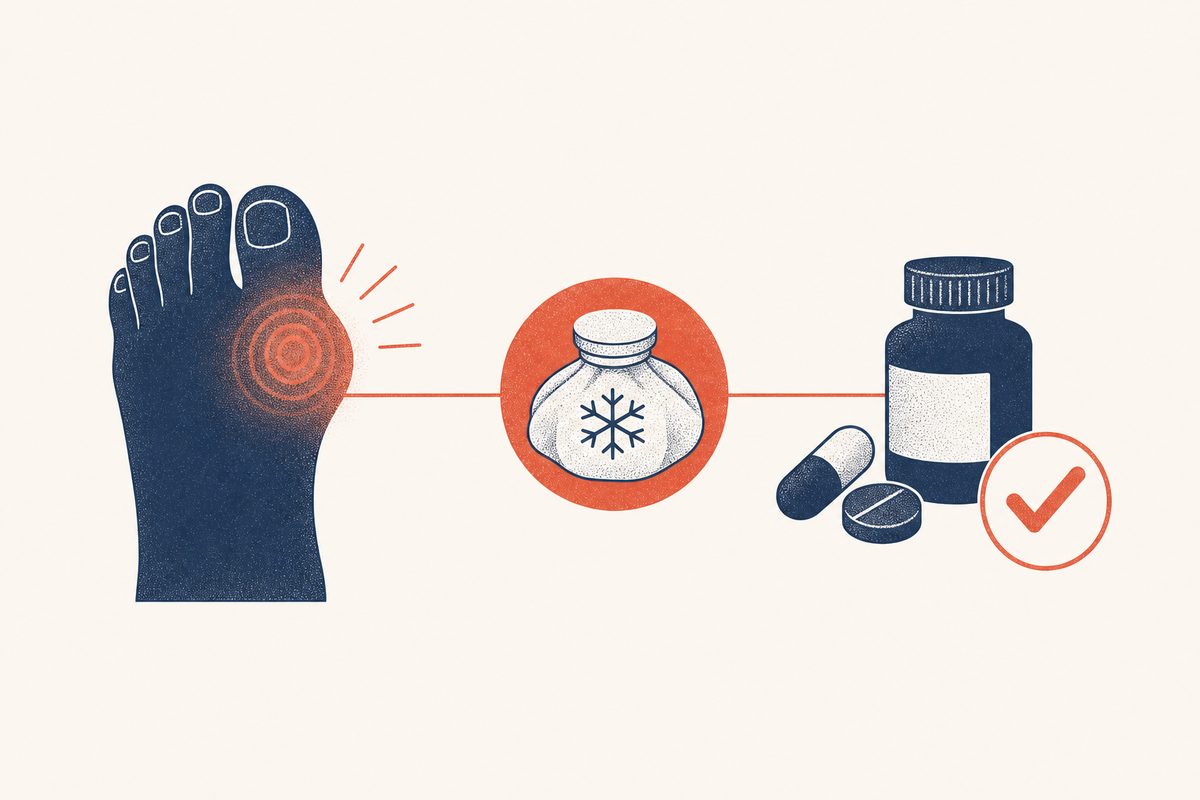
While waiting for medication to work, simple measures help. Rest the joint and avoid bearing weight on it. Apply a cold pack or ice wrapped in a cloth for short intervals to reduce swelling and pain. Elevate the foot or hand. Drink plenty of water, and avoid alcohol during the flare.[1]
The 2020 ACR guideline conditionally recommends topical ice as an adjunct to the first-line medicines, alongside rest.[1] Ice is an add-on, not a replacement for an anti-inflammatory, but it is low-risk and often genuinely helpful in the first hours.
What Not to Do During an Attack
- Do not stop allopurinol or febuxostat during a flare if you already take them. Stopping and restarting can trigger a urate rebound and more attacks. Treat the flare separately.[1][6]
- Do not use old high-dose colchicine (hourly dosing until diarrhea). It causes far more gastrointestinal toxicity with no better pain relief.[2]
- Do not treat gout with aspirin alone. At the doses used for arthritis, aspirin can actually reduce urate excretion and raise urate levels.[1]
- Do not start urate-lowering therapy without a plan for flare prevention. Lowering urate too fast without prophylaxis can paradoxically provoke flares in the first months.[1]
How Long an Attack Lasts (and When Treatment Helps)
An untreated gout flare typically builds over the first 12 to 24 hours to a severe peak and then gradually settles over about one to two weeks.[1] Early treatment shortens both the peak and the tail. The strongest signal from trials is that the sooner an anti-inflammatory is started, ideally within the first 24 hours, the better the response.[2]
Starting urate-lowering therapy during a flare is a separate question. Because the medicines address different problems, a flare does not usually prevent allopurinol from being started when it is otherwise indicated. A randomized trial found no meaningful difference in outcomes between starting allopurinol immediately versus waiting, and the ACR guideline conditionally supports starting urate-lowering therapy during a flare when anti-inflammatory treatment is in place.[6][1]
Preventing the Next Attack
Once the flare settles, the discussion shifts to why it happened. People with tophi, gout-related radiographic damage, or two or more flares a year are candidates for long-term urate lowering, usually with allopurinol, titrated to a serum urate below 6 mg/dL.[1] When urate-lowering therapy is started, the guideline recommends anti-inflammatory prophylaxis, most often low-dose colchicine or an NSAID, to reduce the flare risk that comes with falling urate in the first months.[1]
Recent evidence adds nuance: a 2023 non-inferiority trial found that with the start-low, go-slow allopurinol strategy, adding colchicine prophylaxis may not add much flare prevention for many patients, though clinical practice still commonly uses short-term prophylaxis.[7] See our guides on allopurinol vs colchicine and uric acid levels.
Telehealth or In-Person?
For a recurrent flare in someone with an established gout diagnosis and no warning signs, a synchronous video visit can be appropriate for diagnosis, medication selection, and interaction review, and for these non-controlled prescriptions in every U.S. state.[1] A first-ever hot, swollen joint, an atypical joint pattern, fever, or concern for infection should be seen in person because joint fluid may need to be sampled.[5]
| Situation | Setting |
|---|---|
| Recurrent flare, known gout, no red flags | Telehealth or in-person are both reasonable |
| First-ever suspected gout or unclear diagnosis | In-person (joint aspiration may be needed) |
| Fever, spreading redness, cannot bear weight, severe illness | Urgent in-person or emergency department |
When to Go to the Emergency Department
Seek same-day emergency evaluation for fever or chills with a hot joint, rapidly spreading redness, a wound or break in the skin near the joint, inability to bear weight, confusion or severe weakness, immune suppression, or a new blistering rash after allopurinol. These can signal septic arthritis, a severe infection, or a serious drug reaction rather than an uncomplicated flare.[5]
Septic arthritis can destroy cartilage within days, so when a hot, swollen joint cannot be confidently distinguished from infection, aspiration and culture take priority over guessing.[5]
Frequently Asked Questions
Both are reasonable NSAIDs for a flare when there is no kidney disease, ulcer, or bleeding concern. Naproxen 500 mg twice daily for five days was equivalent to prednisolone in a trial. Use the dose and duration a clinician sets for you.[3]
An untreated flare usually settles over one to two weeks, but waiting prolongs pain and does nothing to reduce recurrent attacks, tophi, or joint damage. Treatment shortens the episode.[1]
No. Continue allopurinol or febuxostat during a flare and treat the flare separately unless a clinician tells you otherwise.[1]
Colchicine starts working within the first day when taken early. In the AGREE trial, 37.8 percent of people had at least 50 percent pain reduction at 24 hours. It works best within the first 24 hours of symptoms.[2]
Yes. Topical ice is a conditional recommendation from the ACR as an adjunct to first-line medicine. Wrap the ice in a cloth and apply for short intervals.[1]
Both are effective. A joint injection is useful for a single joint and less systemic exposure; oral steroids are convenient and work well for most people. The choice depends on the joint, the person, and clinician judgment.[1]
Combining medicines should be directed by a clinician because both can affect the kidneys and stomach. Typically one first-line agent is chosen and adjusted based on response and side effects.[1]
Typically severe pain that peaks within hours, often overnight, with a swollen, warm, red, and exquisitely tender joint, frequently the big toe. Even light touch can hurt.[1]
Both can cause a hot, painful, swollen joint. Crystal analysis of joint fluid is the reference test. Fever, a wound near the joint, and rapid spreading redness favor infection and need urgent evaluation.[5]
Yes. Colchicine, NSAIDs, and prednisone are not controlled substances and can be prescribed by synchronous video visit in every U.S. state for an appropriate, established flare. A first or atypical flare needs in-person assessment.[1]
Treat-to-target urate lowering with allopurinol, anti-inflammatory prophylaxis when starting it, weight loss if overweight, and limiting alcohol and sugar-sweetened drinks are the main evidence-based steps.[1]
References
- FitzGerald JD, Dalbeth N, Mikuls T, et al. 2020 American College of Rheumatology Guideline for the Management of Gout. Arthritis Care & Research. 2020;72(6):744-760. doi:10.1002/acr.24180. https://pmc.ncbi.nlm.nih.gov/articles/PMC10563586/
- Terkeltaub RA, Furst DE, Bennett K, Kook KA, Crockett RS, Davis MW. High versus low dosing of oral colchicine for early acute gout flare. Arthritis & Rheumatism. 2010;62(4):1060-1068. doi:10.1002/art.27327. PMID: 20131255. https://pubmed.ncbi.nlm.nih.gov/20131255/
- Janssens HJ, Janssen M, van de Lisdonk EH, van Riel PL, van Weel C. Use of oral prednisolone or naproxen for the treatment of gout arthritis: a double-blind, randomised equivalence trial. The Lancet. 2008;371(9627):1854-1860. doi:10.1016/S0140-6736(08)60799-0. PMID: 18514729. https://pubmed.ncbi.nlm.nih.gov/18514729/
- U.S. Food and Drug Administration. COLCRYS (colchicine) prescribing information. Updated 2024. https://dailymed.nlm.nih.gov/dailymed/drugInfo.cfm?setid=8a5edd42-f1e5-4a67-a802-e2c0f6d19023
- Newberry SJ, FitzGerald JD, Motala A, et al. Diagnosis of Gout: A Systematic Review in Support of an American College of Physicians Clinical Practice Guideline. Annals of Internal Medicine. 2017;166(1):27-36. doi:10.7326/M16-0462. PMID: 27802505. https://pubmed.ncbi.nlm.nih.gov/27802505/
- Taylor TH, Mecchella JN, Larson RJ, Kerin KD, Mackenzie TA. Initiation of allopurinol at first medical contact for acute attacks of gout: a randomized clinical trial. The American Journal of Medicine. 2012;125(11):1126-1134.e1. doi:10.1016/j.amjmed.2012.05.025. PMID: 23098865. https://pubmed.ncbi.nlm.nih.gov/23098865/
- Stamp L, Horne A, Mihov B, Drake J, Haslett J, et al. Is colchicine prophylaxis required with start-low go-slow allopurinol dose escalation in gout? A non-inferiority randomised double-blind placebo-controlled trial. Annals of the Rheumatic Diseases. 2023;82(12):1626-1634. doi:10.1136/ard-2023-224731. PMID: 37652661. https://pubmed.ncbi.nlm.nih.gov/37652661/