Key Takeaways
- Beer, spirits, sugar-sweetened soft drinks, red meat, organ meats, and some seafood are the foods most repeatedly linked to higher gout risk. [1][2][3][4]
- High-purine vegetables, tofu, and other plant proteins were not associated with gout and do not need to be eliminated. [4]
- Lower-fat dairy is associated with a lower risk of gout, with a relative risk of 0.56 for the highest intake in one cohort. [4]
- Diet lowers urate only modestly and rarely replaces urate-lowering medicine when a person meets guideline criteria. [1]
- Weight loss, less alcohol, and replacing sugar-sweetened drinks with water are among the most evidence-backed changes. [1][5]
- Cherry intake is linked to fewer recurrent attacks in observational data, but cherry supplements are not a substitute for medication. [6]
Foods to Avoid (or Strictly Limit) With Gout
No single food causes gout on its own. Gout develops when serum urate stays above its solubility limit long enough for monosodium urate crystals to form and trigger inflammation.[1] Diet influences that process mainly by how much purine and fructose it delivers and how it affects body weight, kidney urate handling, and insulin resistance.[2]
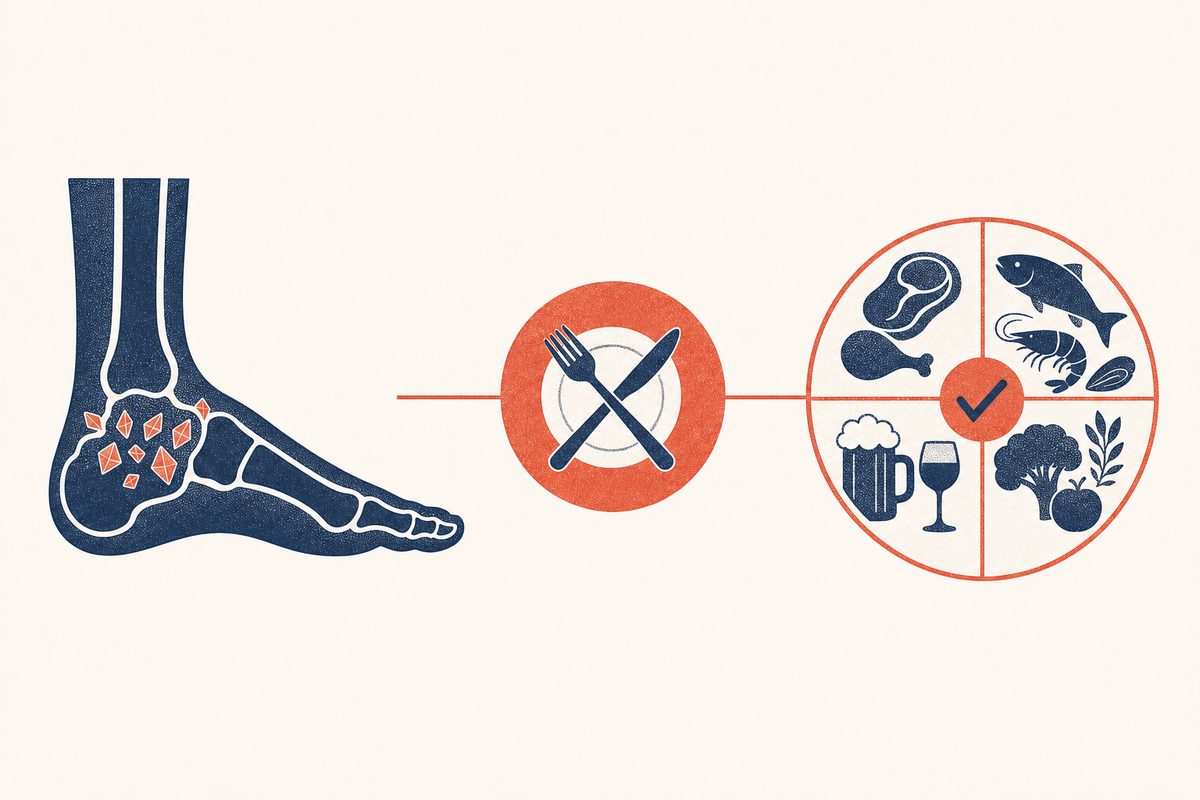
The foods most consistently associated with higher gout risk across the large prospective cohorts are:
- Organ meats (liver, kidney, sweetbreads) have the highest purine content of all foods.[2]
- Certain seafood, especially anchovies, sardines, mussels, scallops, herring, and smelt.[4]
- Red meat and game (beef, lamb, pork, venison).[4]
- Beer and spirits, more than wine.[3]
- Sugar-sweetened drinks and juices with added fructose.[2]
Purine content values are approximate, published food-composition ranges, not precise thresholds. The bigger principle is total eating pattern over time rather than a single high-purine plate.
Why Purines and Fructose Matter
When the body breaks down purines, it produces urate. Purines come both from what we eat and from normal cell turnover, so food is only part of the urate pool.[2] Fructose is different: metabolizing large amounts of fructose consumes phosphate and generates urate while also reducing kidney urate excretion. This is why sugar-sweetened soft drinks, which deliver a large fructose load quickly, show a stronger association with gout than many solid foods.[2]
In a prospective study of roughly 46,000 men, drinking two or more sugar-sweetened soft drinks a day carried a relative risk of 1.85 for gout compared with less than one a month, while diet soft drinks showed no such association.[2] That points to fructose rather than carbonation as the driver.
Meat and Seafood: The Highest-Purine Proteins
In the Health Professionals Follow-up Study, the highest fifth of meat intake was associated with a relative risk of 1.41 for gout, and the highest fifth of seafood intake with a relative risk of 1.51, compared with the lowest intake.[4] The same analysis found that high intake of purine-rich vegetables and of animal or vegetable protein overall were not associated with increased gout risk.[4]
Practical guidance is therefore to moderate, not eliminate, meat and seafood. Oily fish such as sardines and anchovies are concentrated sources of purines and are worth limiting if they are a personal trigger, but ordinary portions of chicken or salmon can usually fit into a balanced gout diet.
Alcohol: Beer and Spirits Carry the Most Risk
Alcohol raises urate both by promoting urate production and by reducing kidney excretion, and beer adds a purine load from brewer's yeast as well.[3] In one prospective cohort, each 12-ounce serving of beer per day was associated with a relative risk of 2.51 for incident gout, and each serving of spirits with a relative risk of 1.60. Wine up to two glasses a day showed no clear association with increased gout risk in that study.[3]
During an active flare, avoiding alcohol is a sensible short-term step, and people who flare when they drink should consider cutting back or stopping.[1] This is not an all-or-nothing rule for everyone, but beer is the drink most worth limiting.
Sugar, Fructose, and Sweetened Drinks
Sugar-sweetened soft drinks and fruit drinks are the clearest dietary fructose concern because they deliver fructose rapidly and in large amounts. Higher intake of fructose from these sources is associated with higher gout risk, while artificially sweetened drinks are not.[2] Whole fruit is different from sweetened drinks because fruit also supplies fiber and water, and moderate fruit intake is not a major gout concern in the same way.
High-fructose corn syrup, used as a sweetener in many soft drinks and processed foods, is metabolized to urate in the liver and is called out by the 2020 ACR guideline as something to limit.[1]
Foods That May Help
The dietary factors associated with lower gout risk form a coherent pattern: lower-fat dairy, whole grains, vegetables, legumes, coffee, and less sugar and alcohol. Higher intake of lower-fat dairy was associated with a relative risk of 0.56 for gout, and the highest adherence to a DASH-style diet with a hazard ratio of 0.68.[4][8] Drinking four or more cups of coffee a day was associated with a relative risk of 0.60 in a separate prospective cohort.[7]
Vegetables, Dairy, and Plant Protein
A persistent myth holds that spinach, mushrooms, asparagus, and other high-purine vegetables trigger gout. Prospective data do not support this: high-purine vegetable intake was not associated with gout risk in the large Health Professionals Follow-up Study.[4] Plant proteins such as tofu and legumes also appear neutral for gout, and they can replace some animal protein without raising urate.
Lower-fat dairy deserves special mention because it is consistently associated with lower gout risk and also appears to modestly lower serum urate in short-term studies.[4] Choosing lower-fat milk and yogurt over sugar-sweetened alternatives is a repeatable, evidence-supported swap.
Coffee, Water, and Vitamin C
Water and coffee are both reasonable choices for people with gout. Staying well hydrated supports kidney urate clearance, and coffee intake was associated with lower gout risk in prospective data.[7] Coffee should not be started solely as a urate-lowering strategy, but people who already drink it do not need to stop.
Vitamin C has a tiny, clinically insignificant effect in randomized testing: 500 mg daily lowered serum urate by only about 0.014 mg/dL in one pilot randomized trial, so megadoses are not a gout treatment.[9] Cherry consumption is a different story, a case-crossover study found cherry intake over the prior two days was associated with 35 percent lower odds of a recurrent attack (odds ratio 0.65), but this is observational and cherry servings were about a cup, not a supplement.[6]
Weight Loss and Diet Patterns
Obesity is one of the strongest modifiable drivers of gout because it raises urate production and reduces kidney excretion.[5] The 2020 ACR guideline conditionally recommends weight loss for people with gout who are overweight or obese, and limiting alcohol, purines, and high-fructose corn syrup.[1] Even modest, sustained weight loss can lower serum urate, though the effect is gradual and smaller than what urate-lowering medication achieves.
A DASH-style pattern, emphasis on vegetables, fruit, whole grains, legumes, low-fat dairy, and less red meat, sugar, and sodium, is a good default because it matches both the gout evidence and general cardiometabolic health.[8] Gout commonly travels with hypertension, kidney disease, and diabetes, so a heart-healthy eating pattern serves more than the joints.[5]
Diet vs Medication: What Actually Lowers Urate
Diet supports treatment but is almost never a substitute for it. The ACR guideline makes treat-to-target urate lowering with a xanthine oxidase inhibitor such as allopurinol the backbone of long-term control for people with tophi, gout-related radiographic damage, or two or more flares a year.[1] A low-purine diet alone often lowers serum urate by well under 1 mg/dL, which may not be enough to reverse crystal deposition for someone whose urate is meaningfully elevated.
Think of it as two tools with different jobs: medication lowers urate below the crystallization threshold and dissolves existing crystals over months to years, while diet removes avoidable triggers and supports weight and cardiovascular health.[1][5] See our companion guides on uric acid levels and gout attack treatment for the full picture.
A Practical Gout Plate
| Category | Limit or avoid | Reasonable choice |
|---|---|---|
| Protein | Organ meats, game, anchovies, sardines, mussels, herring | Modest chicken, turkey, eggs, tofu, legumes, lower-fat dairy |
| Drinks | Beer, spirits, sugar-sweetened soda, sweetened juices | Water, coffee, tea, lower-fat milk, modest wine if tolerated |
| Vegetables | None need eliminating | All vegetables including spinach and mushrooms |
| Dairy | Full-fat, sweetened dairy desserts | Low-fat milk and plain yogurt |
| Grains and fruit | Fruit drinks and juices with added sugar | Whole grains and whole fruit |
Use this as a flexible map rather than a rigid ban list. The most important single swaps are beer to water, sugar-sweetened drinks to water or plain dairy, and organ meats or anchovy-heavy dishes to plant or lean protein.
Dietary Factors by Strength of Association
| Factor | Association with gout | Bottom line |
|---|---|---|
| Beer | Relative risk 2.51 per serving per day | Highest-risk drink, worth limiting |
| Sugar-sweetened soft drinks | Relative risk 1.85 for two or more per day | Replace with water or plain dairy |
| Seafood (high intake) | Relative risk 1.51 | Limit oily high-purine fish |
| Meat (high intake) | Relative risk 1.41 | Moderate portions |
| Lower-fat dairy (high intake) | Relative risk 0.56 | Favorable, worth including |
| High-purine vegetables | No association | No need to avoid |
These figures come from the large prospective cohorts, interpreted as associations, not proof that any single item causes or cures gout.[3][4][2]
Diet Myths vs the Evidence
| Common claim | What the evidence shows |
|---|---|
| "Spinach and mushrooms must be avoided" | High-purine vegetables were not associated with gout risk.[4] |
| "Apple cider vinegar cures gout" | No reliable clinical evidence supports this. |
| "Vitamin C megadoses lower urate" | 500 mg daily lowered urate by only 0.014 mg/dL in a randomized trial.[9] |
| "Tart cherry supplements replace medicine" | Cherries reduced flare odds in observational data, but supplements are not a substitute for urate-lowering therapy.[6] |
| "Diet alone controls gout" | Diet lowers urate modestly; treat-to-target medication does the heavy lifting when indicated.[1] |
When Diet Is Not Enough
Diet alone is unlikely to control gout when a person has frequent flares, tophi, kidney disease, or a serum urate that stays well above target despite dietary effort.[1] If you keep flaring despite careful eating, the right next step is clinician-guided urate-lowering therapy, not a stricter diet. A first-ever hot, swollen joint also needs in-person evaluation to confirm the diagnosis and rule out infection before any diet plan applies.
Diet myth check: Apple cider vinegar, baking soda, and celery seed lack reliable evidence for gout. Vitamin C megadoses move urate by a clinically meaningless amount.[9] Focus on the changes above and on clinician-guided urate lowering.
Frequently Asked Questions
Bananas are not high in purines and are not a documented gout trigger. Like most whole fruit, they are a neutral to acceptable choice. The bigger fructose concern is sugar-sweetened drinks, not whole fruit.[2]
Tomatoes are sometimes anecdotally reported as a trigger, but they have not emerged as a consistent gout risk factor in large prospective studies. If you repeatedly notice flares after eating them, you can test your own tolerance.
Modest portions of chicken are generally acceptable. Chicken has less purine than organ meats, sardines, and anchovies. Portion size and the overall pattern matter more than a single food.[4]
Shellfish is a moderate to high purine food and was associated with higher gout risk in prospective data, so it is worth limiting, especially scallops, mussels, and shrimp if they are a personal trigger.[4]
Both fructose-sweetened drinks and high meat intake are linked to gout risk. The clearest removable dietary risk is sugar-sweetened beverages, which show a strong and specific association.[2]
Staying well hydrated supports kidney urate excretion and helps reduce the risk of urate stone formation, though there is less direct trial evidence for water alone. It is a low-risk, sensible habit.[1]
Eggs are very low in purines and are a useful source of protein for people with gout who are limiting higher-purine meats and seafood.
Whole grains including oatmeal are part of a DASH-style pattern associated with lower gout risk and are a reasonable choice.[8]
Weight loss, less alcohol, and fewer sugar-sweetened drinks lower urate over weeks to months, but the effect is modest. Medication reaches the urate target much more reliably than diet alone.[1]
This depends on your pattern. Beer and spirits carry the most gout risk. Some people can tolerate occasional wine, but the safest advice during and soon after a flare is to avoid alcohol entirely.[3]
In prospective data, higher coffee intake was associated with lower gout risk. Coffee is not a treatment, but people who drink it can continue.[7]
No. High-purine seafood such as sardines, anchovies, mussels, and herring is most worth limiting. Moderate portions of lower-purine fish can usually fit into a balanced gout diet.[4]
References
- FitzGerald JD, Dalbeth N, Mikuls T, et al. 2020 American College of Rheumatology Guideline for the Management of Gout. Arthritis Care & Research. 2020;72(6):744-760. doi:10.1002/acr.24180. https://pmc.ncbi.nlm.nih.gov/articles/PMC10563586/
- Choi HK, Curhan G. Soft drinks, fructose consumption, and the risk of gout in men. BMJ. 2008;336(7639):309-312. doi:10.1136/bmj.39449.819271.BE. PMID: 18244959. https://pubmed.ncbi.nlm.nih.gov/18244959/
- Choi HK, Atkinson K, Karlson EW, Willett W, Curhan G. Alcohol intake and risk of incident gout in men: a prospective study. The Lancet. 2004;363(9417):1277-1281. doi:10.1016/S0140-6736(04)16000-5. PMID: 15094272. https://pubmed.ncbi.nlm.nih.gov/15094272/
- Choi HK, Atkinson K, Karlson EW, Willett W, Curhan G. Purine-rich foods, dairy and protein intake, and the risk of gout in men. New England Journal of Medicine. 2004;350(11):1093-1103. doi:10.1056/NEJMoa035700. PMID: 15014182. https://pubmed.ncbi.nlm.nih.gov/15014182/
- Kuo CF, Grainge MJ, Zhang W, Doherty M. Global epidemiology of gout: prevalence, incidence and risk factors. Nature Reviews Rheumatology. 2015;11(11):649-662. doi:10.1038/nrrheum.2015.91. PMID: 26150127. https://pubmed.ncbi.nlm.nih.gov/26150127/
- Zhang Y, Neogi T, Chen C, Chaisson C, Hunter DJ, Choi HK. Cherry consumption and decreased risk of recurrent gout attacks. Arthritis & Rheumatism. 2012;64(12):4004-4011. doi:10.1002/art.34677. PMID: 23023818. https://pmc.ncbi.nlm.nih.gov/articles/PMC3510330/
- Choi HK, Willett W, Curhan G. Coffee consumption and risk of incident gout in men: a prospective study. Arthritis & Rheumatism. 2007;56(6):2049-2055. doi:10.1002/art.22712. PMID: 17530645. https://pubmed.ncbi.nlm.nih.gov/17530645/
- Rai SK, Fung TT, Lu N, Keller SF, Curhan GC, Choi HK. The Dietary Approaches to Stop Hypertension diet, Western diet, and risk of gout in men. BMJ. 2017;357:j1794. doi:10.1136/bmj.j1794. PMID: 28487277. https://pubmed.ncbi.nlm.nih.gov/28487277/
- Stamp LK, O'Donnell JL, Frampton C, Drake JM, Zhang M, Chapman PT. Clinically insignificant effect of supplemental vitamin C on serum urate in patients with gout: a pilot randomized controlled trial. Arthritis & Rheumatism. 2013;65(6):1636-1642. doi:10.1002/art.37925. PMID: 23681955. https://pubmed.ncbi.nlm.nih.gov/23681955/