Key Points
- For moderate-to-severe poison ivy, guidance supports starting prednisone at about 0.5 to 1 mg/kg per day (roughly 40 to 60 mg) and tapering over 14 to 21 days.[1],[2]
- Short courses are the problem: 3-day, 5-day, and 6-day regimens frequently end before the immune reaction finishes, causing a rebound flare.[3],[4]
- The 6-day Medrol Dose Pack delivers only about 84 mg of methylprednisolone and is repeatedly described as insufficient for poison ivy.[4]
- A mild, localized rash usually needs no oral steroid at all, only a topical corticosteroid.[1]
- Dosing is individualized. This guide explains the evidence; a clinician sets the actual prescription.
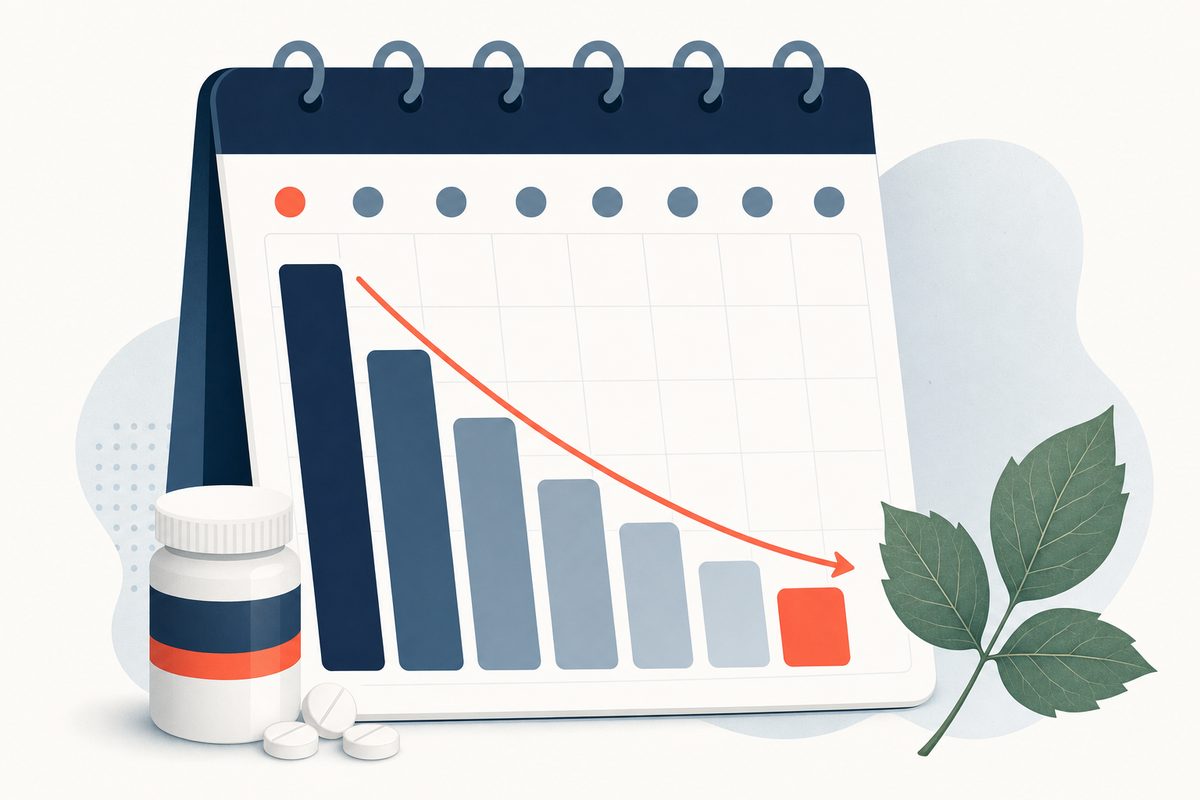
Search the phrase "prednisone dosage for poison ivy" and you will find dozens of conflicting numbers: 3-day bursts, 5-day courses, the familiar 6-day Medrol Dose Pack, 10-day plans, and long tapers stretching past three weeks. The confusion is understandable, because different clinicians genuinely prescribe different lengths. This guide walks through what the published evidence actually supports for oral and topical steroid treatment of urushiol dermatitis, why the length of the course matters more than the exact starting number, and how to tell whether a short course you were given is likely to hold.
This is an educational reference, not a prescription. Steroid dosing depends on the size and location of the rash, body weight, and other medical conditions, so the specific plan should always come from a clinician who has assessed the rash.
When Oral Steroids Are Actually Needed
Most poison ivy rashes never need oral steroids. A small, localized patch on an arm or leg typically responds to a prescription topical corticosteroid, cool compresses, and time. Oral prednisone is reserved for reactions that topical treatment cannot reach or control.[1]
Family-medicine and dermatology guidance generally reserves systemic steroids for these situations:[1],[7]
- Rash involving the face, eyes, or eyelids, where swelling can affect vision
- Rash involving the genitals
- Rash on the hands that limits function
- Rash covering more than about 20% of body surface area
- Severe blistering or large bullae
- A rash that keeps spreading despite good topical care
If none of those apply, a longer oral course usually adds side-effect risk without meaningful benefit over topical treatment.
How Much Prednisone
For a rash severe enough to warrant systemic treatment, the starting dose most consistently cited is 0.5 to 1 mg per kilogram of body weight per day, which works out to roughly 40 to 60 mg daily for a typical adult.[1],[2] The dose is usually taken once in the morning, with food, to line up with the body's own cortisol rhythm and to reduce stomach upset.
A common mistake is under-dosing rather than over-dosing. A rash that keeps advancing on 20 mg a day is often a sign the starting dose was too low for the severity, not that steroids are failing.[2] This is one reason self-adjusting an old leftover prescription is a poor idea: the right dose is tied to the rash and the person.
How Long: The 14 to 21-Day Taper
Duration is where poison ivy treatment most often goes wrong. The urushiol reaction is a delayed, type IV immune response that can take up to two weeks to fully express itself in sensitized skin. If the steroid stops before that process is complete, the inflammation simply resumes.[3]
For that reason, guidance for moderate-to-severe rhus (poison ivy) dermatitis calls for tapering oral prednisone over two to three weeks rather than stopping abruptly.[1],[2] A representative tapered schedule from the trial literature looks like this:[3]
| Phase | Prednisone dose | Duration |
|---|---|---|
| Initial | 40 to 60 mg daily (0.5 to 1 mg/kg/day) | 5 to 7 days |
| First step down | 30 mg daily | 2 to 3 days |
| Second step down | 20 mg daily | 2 to 3 days |
| Third step down | 10 mg daily | 2 to 3 days |
| Final step | 5 mg daily | 3 to 4 days |
| Total | About 14 to 21 days | |
The exact numbers vary between clinicians, but the shape is what matters: a solid starting dose held long enough to control the rash, then a gradual step-down so the immune reaction does not rebound as the drug clears.
Common Regimens Compared
Here is how the regimens people are most often prescribed line up against the evidence for a moderate-to-severe rash.
| Regimen | What it delivers | What the evidence says |
|---|---|---|
| 3-day burst | A few days at 20 to 40 mg, no taper | Far below the durations studied. Rebound is likely once it stops. |
| 5-day course | 40 mg daily for 5 days (about 200 mg total) | The short arm of the 2014 randomized trial. These patients needed extra medication far more often than the longer arm (55.6% vs. 22.7%).[3] |
| 6-day Medrol Dose Pack | 84 mg methylprednisolone tapered over 6 days | Convenient but repeatedly described as insufficient in dose and duration; a frequent cause of rebound.[4] |
| 7-day course | Roughly 40 mg daily for a week | A fine opening stretch, but courses of a week or less are the ones expert guidance ties to rebound in poison ivy.[5] |
| 10-day course | A week and a half, with or without a taper | Better, but still under 14 days. One emergency-medicine analysis found courses under 14 days had higher odds of a return visit.[4] |
| 14 to 21-day taper | 40 to 60 mg to start, stepped down over 2 to 3 weeks | The approach supported by AAFP guidance and the available trial data for moderate-to-severe rashes.[1],[2],[3] |
The Medrol Dose Pack Problem
The 6-day methylprednisolone (Medrol) Dose Pack is one of the most commonly dispensed steroid regimens in urgent care and emergency departments, largely because it is pre-packaged and easy to hand out. The pack tapers across six days: 24 mg, then 20, 16, 12, 8, and finally 4 mg, for a total of about 84 mg of methylprednisolone.[4]
The trouble is that this total is modest and the course is short. For a delayed immune reaction that can run for two weeks, a six-day pack often stops right as the inflammation is peaking. The dermatology and family-medicine literature has flagged the dose pack as insufficient in both dose and duration for poison ivy, and a specific driver of rebound rash.[1],[4]
If you finished a dose pack and the rash returned
A rash that comes back or worsens in the days after a Medrol Dose Pack is the textbook pattern of an undertreated course, not a treatment failure or a new exposure. The usual next step is a longer, tapered prednisone course rather than repeating the pack, which a clinician can arrange in person or through a telehealth poison ivy and oak visit.
Methylprednisolone and Injectable Options
Methylprednisolone is the same drug found in the Medrol Dose Pack; the issue with the pack is the packaging and length, not the molecule. Prescribed as plain methylprednisolone at an adequate daily dose and duration, it can treat poison ivy much like prednisone.[4] The two are close cousins, with about 4 mg of methylprednisolone roughly equivalent to 5 mg of prednisone.
For very severe rashes where swallowing pills reliably is a concern, some clinicians use a single intramuscular corticosteroid injection. The FDA label for methylprednisolone acetate lists 80 to 120 mg intramuscularly for acute severe poison ivy dermatitis, with relief often within 8 to 12 hours.[6] This is a matter of clinical judgment, and not everyone agrees: some family-medicine guidance considers long-acting injectable steroids poorly supported for contact dermatitis and favors an oral taper instead.[1] An injection is best thought of as one option a clinician may weigh, not a standard step.
Rebound Dermatitis: Why It Happens
Rebound dermatitis is the return, and sometimes worsening, of the rash shortly after a steroid course ends. It is the single most common reason poison ivy is mismanaged.[2]
The mechanism is straightforward. The steroid suppresses the immune reaction, but it does not remove the sensitization or speed up how fast the body clears the allergic response. When a short course wears off before the reaction has run its natural two-week course, the inflammation returns to a still-primed immune system. A randomized trial found that patients on a 5-day course needed supplementary medication more than twice as often as those on a 15-day taper (55.6% vs. 22.7%), and a larger emergency-medicine analysis linked courses shorter than 14 days to higher odds of a return healthcare visit.[3],[4] The fix for rebound is generally a longer, properly tapered course, not a higher one-time dose.
Topical Steroids for Milder Rashes
When the rash is localized and not on the face or genitals, a prescription topical corticosteroid is often all that is needed, and it avoids the systemic side effects of oral steroids entirely. Potency should be matched to the location:[1]
- High-potency (for the trunk, arms, and legs): clobetasol propionate 0.05% or betamethasone dipropionate 0.05%. These outperform over-the-counter hydrocortisone for an established rash.
- Mid-potency: triamcinolone acetonide 0.1% (Kenalog), one of the agents named in family-medicine guidance for localized allergic contact dermatitis.
- Low-potency (for the face and skin folds): desonide 0.05% or over-the-counter hydrocortisone 1%, which lower the risk of skin thinning in delicate areas.
High-potency topicals should be avoided on the face, eyelids, and genitals. For a widespread rash, topical treatment alone is usually not enough, which is when the oral options above come into play.
Side Effects and Safety of a Short Course
A two to three-week prednisone course is short by steroid standards, and for an otherwise healthy adult it usually does not require lab monitoring.[2] The common, temporary effects include trouble sleeping, increased appetite, mood changes, and a modest rise in blood sugar, which matters most for people with diabetes. Taking the dose in the morning with food helps.
People with diabetes, high blood pressure, glaucoma, a history of stomach ulcers, certain infections, or who are pregnant should tell their clinician before starting, since the plan may need to be adjusted. The taper itself is part of the safety picture: stepping the dose down rather than stopping suddenly is what allows the body to resume its own cortisol production smoothly.
What to Do If the Rash Comes Back
If the rash returns after a short course, a few things are worth checking before assuming the steroids did not work:
- Was the course long enough? A return within days of finishing a 3 to 7-day course or a dose pack points to duration, not drug choice.
- Is there ongoing exposure? Urushiol lingers on unwashed clothing, gardening tools, shoes, and pet fur, and can re-trigger the rash. Washing these removes the source.
- Was the starting dose high enough for the severity? A rash that never fully settled may have been under-dosed from the start.
In most cases the remedy is a longer, tapered course. That decision, and the prescription, should come from a clinician who can look at the rash.
Getting a Prescription
Poison ivy is well suited to remote evaluation because the diagnosis is largely visual: linear streaks, blisters, intense itch, and a history of outdoor exposure are usually enough, and a clear photo or video shows the same thing an in-person exam would.
Whichever route you choose, a visit can assess how severe the rash is, decide whether topical treatment is enough or an oral course is warranted, and set an appropriate length and taper so the rash does not rebound. If you would rather be seen face to face, an urgent care or primary care office can do the same. If you prefer to avoid a waiting room, a telehealth poison ivy and oak visit can provide an assessment and, when appropriate, a prescription, often within hours.
Seek in-person or emergency care instead of a virtual visit if there is significant facial swelling affecting vision, any trouble breathing or swallowing (which can follow exposure to smoke from burning the plants), or signs of a skin infection such as spreading redness, warmth, pus, or fever.
For the full picture on identifying the plants, decontamination, and treating the rash beyond dosing, see the complete poison ivy, oak, and sumac treatment guide.
Frequently Asked Questions
For a rash severe enough to need oral steroids, guidance supports a starting dose of about 0.5 to 1 mg per kilogram of body weight per day, which is roughly 40 to 60 mg for a typical adult, tapered over 14 to 21 days. The exact dose depends on the rash and the person, so it should be set by a clinician rather than copied from a leftover prescription.
Usually not, for a moderate-to-severe rash. In a randomized trial, patients on a 5-day course needed extra medication more than twice as often as those on a longer taper, and expert guidance links courses of a week or less to rebound in poison ivy. A 5 or 7-day stretch can work as the opening of treatment, but the total course generally needs to reach about 14 to 21 days.
The 6-day pack delivers only about 84 mg of methylprednisolone and finishes in under a week. The urushiol reaction can take up to two weeks to run its course, so the steroid often stops before the inflammation does, and the rash flares back. Dermatology and family-medicine sources describe the pack as insufficient in both dose and duration for poison ivy.
Yes. Methylprednisolone is the same drug in the Medrol Dose Pack, and at an adequate daily dose and length it treats poison ivy much like prednisone. The problem with the dose pack is its short duration and modest total dose, not the molecule. Prescribed as plain methylprednisolone for a long enough course, it works comparably.
Usually not. A small, localized rash that is not on the face or genitals typically responds to a prescription topical corticosteroid such as triamcinolone 0.1% or clobetasol 0.05%, along with cool compresses and time. Oral prednisone is reserved for widespread rashes, high-risk locations like the face and genitals, or severe blistering.
References & Sources
- Usatine RP, Riojas M. Diagnosis and Management of Contact Dermatitis. American Family Physician. 2010;82(3):249–255. aafp.org/pubs/afp/issues/2010/0801/p249.html
- Guin JD, et al. Poison Ivy, Oak and Sumac Contact Dermatitis. American Family Physician. 2000;61(11):3408. aafp.org/pubs/afp/issues/2000/0601/p3408.html
- Curtis G, Lewis AC. Treatment of Severe Poison Ivy: A Randomized, Controlled Trial of Long Course vs. Short Course Oral Prednisone. Journal of Clinical Medicine Research. 2014;6(5):429–434. pmc.ncbi.nlm.nih.gov/articles/PMC4169084/
- Butt M, Flamm A, Marks JG, Flamm A. Poison Ivy Dermatitis Treatment Patterns and Utilization: A Retrospective Claims-based Analysis. Western Journal of Emergency Medicine. 2022;23(4):481–488. pmc.ncbi.nlm.nih.gov/articles/PMC9391006/
- Grossman SK, et al. Short-Term Systemic Corticosteroids: Appropriate Use in Primary Care. American Family Physician. 2020;101(2):89–94. aafp.org/pubs/afp/issues/2020/0115/p89.html
- Pfizer. Methylprednisolone Acetate (Depo-Medrol) prescribing information. U.S. Food and Drug Administration label. labeling.pfizer.com/ShowLabeling.aspx?id=12857
- American Academy of Dermatology. Poison ivy, oak, and sumac: How to treat the rash. AAD, 2026. aad.org/public/everyday-care/itchy-skin/poison-ivy/treat-rash