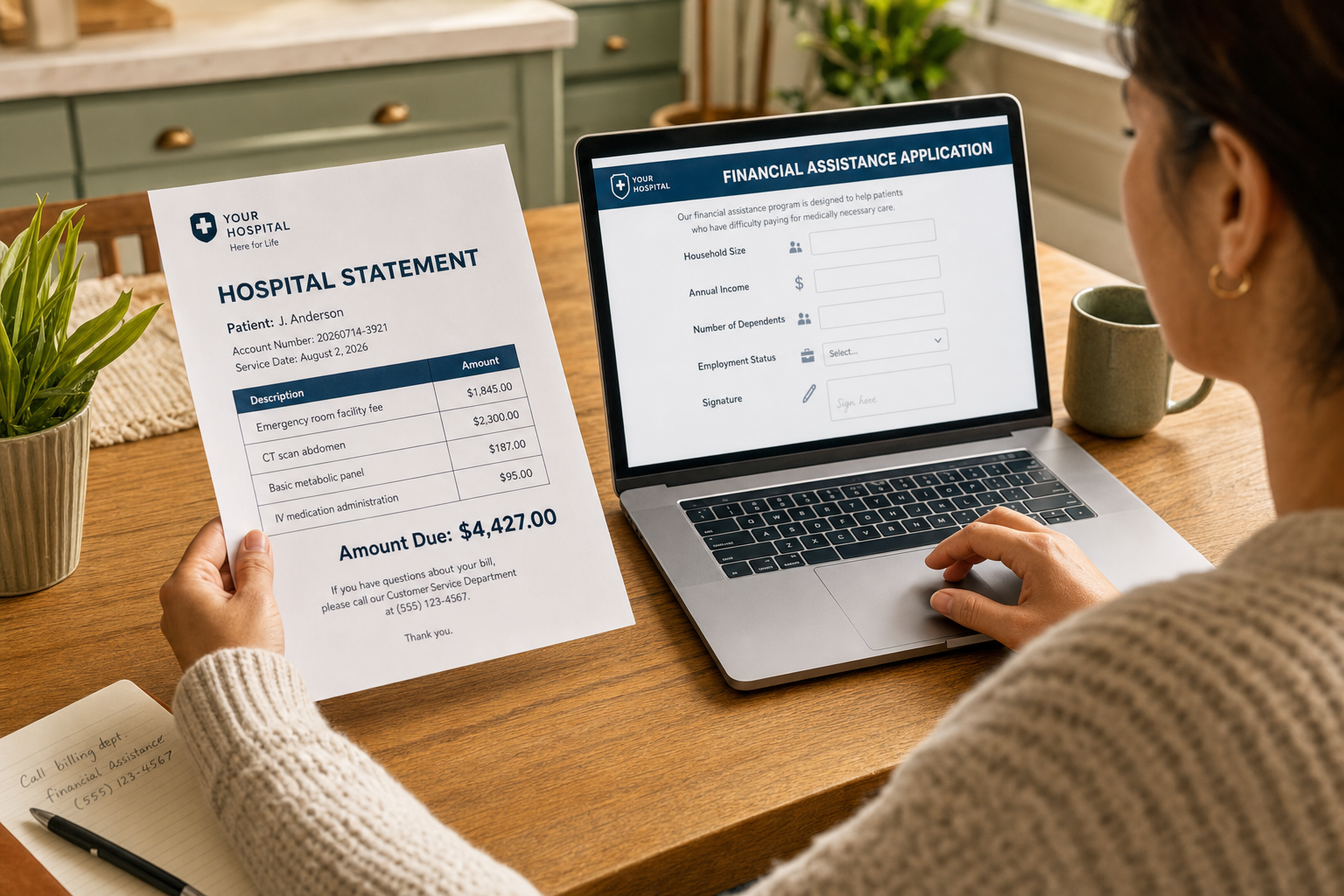
Before you do anything: what the bill actually is.
A medical bill is a request for payment. It may arrive before insurance processing, a coding correction, or financial-assistance review is finished. Do not assume the first total is final. Put the bill, insurance explanation of benefits, and any estimate in one place.
First, identify who sent it. A hospital account may be separate from bills for an emergency physician, radiologist, anesthesiologist, ambulance company, laboratory, or other clinician group. A hospital FAP may cover hospital charges but not every independent clinician who worked there. Federal guidance requires a nonprofit hospital's policy to state which providers are covered and which are not. (IRS Financial Assistance Policies)
If you had insurance, compare the bill to your explanation of benefits. The explanation is not a bill. It shows how the plan processed a claim and what it says you owe. Ask the plan whether the claim is still under review before paying an amount you believe is wrong.
If you were uninsured or chose not to use insurance, locate any good faith estimate you received. The No Surprises Act created protections against certain surprise bills beginning in 2022, and it also created a patient-provider dispute route for some uninsured or self-pay patients. (CMS No Surprises Act fact sheet)
Identify the biller, request records, check insurance or an estimate, then ask what financial-assistance options are open. Billing offices handle these questions every day.
Your rights when a nonprofit hospital bills you.
The federal floor applies to tax-exempt 501(c)(3) organizations that operate hospital facilities. It does not automatically apply to for-profit or government hospitals. A covered nonprofit hospital must establish a written FAP and a written emergency medical care policy. (IRS Financial Assistance Policies) (26 CFR § 1.501(r)-4)
The FAP must apply to emergency and other medically necessary care, set out eligibility criteria, explain whether help includes free or discounted care, describe how charges are calculated, and explain how to apply. It must also be widely publicized. (26 CFR § 1.501(r)-4) This is why asking for the policy is more useful than asking whether the hospital can "help." The written document should tell you the route in.
Ask for the plain-language summary, full application, and list of covered providers. If English is not your preferred language, ask for translated materials. Keep a note of the date, department, and staff member.
Some hospitals also use presumptive eligibility. In this setting, the hospital uses information already available to it to identify people who may qualify, rather than waiting for a complete application. The exact method varies by hospital. Ask directly: “Do you have presumptive eligibility or an automatic screening process for financial assistance?”
Collection limits matter too. Before a covered nonprofit hospital takes extraordinary collection actions, it must make reasonable efforts to determine whether a patient qualifies under its FAP. Those actions include selling debt, reporting adverse information to credit bureaus, certain legal actions, and withholding medically necessary care because of unpaid earlier bills. (26 CFR § 1.501(r)-6)
What charity care actually is (and what it isn't).
Charity care is financial help that reduces or removes a qualifying patient's bill. It is not a synonym for a payment plan. A payment plan divides the amount due over time. Charity care changes the amount due if you meet the hospital's policy. Many hospitals call the same process financial assistance, free care, discounted care, or a sliding-scale program.
Federal law requires a covered nonprofit hospital to publish its own eligibility criteria. It does not set one national income cutoff for every hospital. (26 CFR § 1.501(r)-4) Household income, household size, insurance status, medical bills, and residency rules may be considered under a particular policy. Read the hospital's policy rather than relying on a rule of thumb from another system.
States can add protections. California's Hospital Fair Pricing Act provides statewide hospital fair-billing rules, and the state Hospital Fair Billing Program began enforcement of expanded provisions on January 1, 2024. (California HCAI Laws & Regulations) In Illinois, a non-rural hospital must provide a discount to any uninsured patient with family income up to 600% of the federal poverty guidelines for services exceeding $150 in one admission or encounter, and a full 100% charitable discount for the same services when family income is up to 200% FPL. Rural and Critical Access Hospitals apply a 300% FPL discount threshold and a 125% FPL charitable-discount threshold, with a $300 service threshold. (210 ILCS 89/10) Georgia's DSH rules define a medically indigent person as having income no greater than 200% of the federal poverty guidelines, but that state rule is tied to designated Disproportionate Share Hospitals. (Ga. Comp. R. & Regs. 111-3-6)
The practical distinction is simple. Apply for charity care before you agree that the balance is simply yours to repay. If the answer is no, ask for the written reason and move to discounts or a payment arrangement. Evidence-informed billing guidance supports that order because it preserves options while the account is still with the provider.
How to request charity care, step by step.
- Find the right office. Call the number on the bill and ask for financial assistance, patient financial services, charity care, or the FAP application. If you are in the hospital, a financial counselor or social worker may be able to point you there.
- Ask for three items in writing. Request the full FAP, its plain-language summary, and the application. Also ask whether your account can be placed on hold while the application is reviewed.
- Gather the documents the hospital requests. Common requests can include recent pay stubs, a prior tax return, bank statements, proof of household size, and proof of income changes. A policy may accept alternatives if you do not have one of those documents. Ask, do not guess.
- Complete the application carefully. List every bill number the application should cover. Include a brief written note if your income dropped, you lost coverage, or a one-time medical event changed your finances.
- Submit it in a traceable way. Use the hospital portal if available, or keep a copy, confirmation page, fax record, or mailing receipt. Write down the submission date.
- Follow up. Ask when a decision is expected, whether anything is missing, and how you will receive the decision. If the application is denied, request the policy section used for the decision and ask whether there is an appeal or reconsideration process.
For a nonprofit hospital, submit as soon as you can. Federal collection rules provide a minimum 240-day application period beginning with the first post-discharge billing statement, but waiting does not improve your position. (26 CFR § 1.501(r)-6) During the review, keep opening mail and responding to requests. An incomplete application can slow the process.
You may qualify even if you have insurance. A high deductible, coinsurance amount, or loss of income may fit the hospital's own policy. The policy, not a billing representative's first answer, is the document to use.
The itemized bill: request, review, dispute.
Ask for an itemized statement before paying a large or confusing balance. It should separate charges by date and service rather than showing only one account total. You can also request the billing codes associated with the entries. This gives you a concrete list to compare with what happened during the visit, your insurance explanation of benefits, and any estimate you received.
Read it slowly. Look for entries that appear twice, a charge dated when you were not there, a service you do not recognize, or a mismatch between a hospital bill and a separate clinician bill. A charge can be legitimate and still need explanation. Do not accuse staff of fraud. Ask for the record or explanation behind the line item.
For outpatient care, clarify whether the bill includes both a clinician charge and a facility charge. For an emergency visit, identify whether professional and facility bills came from different organizations. If you see code labels you do not understand, ask the biller to explain what service the code represents and whether it was submitted to your insurer.
A dispute should be specific. Write the account number, date of service, line item, and question. Ask the billing office to note the dispute and to tell you what documents it needs to review the charge. Keep copies of every message. If insurance denied a claim, ask the plan for the denial reason and appeal instructions.
For insured patients, the No Surprises Act may matter when the bill involves emergency services, out-of-network providers at an in-network facility, or out-of-network air ambulance services. (CMS No Surprises Act hub) That protection is not a general promise that every unexpected charge is invalid. Match the details of your care to the CMS description before treating it as a surprise-billing dispute.
Negotiating the bill: what actually works.
Negotiation starts after you know what you are negotiating. Get the itemized statement, check for financial assistance, and find out whether insurance or a good faith estimate is involved. Then ask the billing office what choices it can offer. The answer may be a discount, a payment arrangement, a review, or no change. Policies vary by hospital and by account.
There are three useful questions. First: “Do I qualify for financial assistance under your written policy?” Second: “Is there a self-pay or prompt-pay discount available for this account?” Third: “If I cannot pay the total, what written payment options or settlement review process do you offer?” Ask them separately. A representative may otherwise move immediately to the only option visible in their system.
A settlement offer is a proposal, not a right. Make an offer you can actually pay. If the hospital accepts less than the full balance, get written confirmation that it resolves the account before sending money. For a payment plan, ask about interest, fees, automatic withdrawals, and consequences for a missed payment. Do not promise a payment that will destabilize essentials.
You can also ask how the hospital calculated the amount for an uninsured patient and whether the policy permits a review of the charge. A covered nonprofit hospital's FAP must state the basis used to calculate amounts charged to patients. (26 CFR § 1.501(r)-4) That does not require a particular negotiated result. It does give you a reason to request the written policy rather than negotiate from a vague total.
Put every agreement in writing. A verbal promise is hard to prove later. If the answer is no, ask what information would support reconsideration, then decide whether a payment plan, a formal dispute, Medicaid screening, or legal aid is the next path.
Exactly what to say: three scripts.
Use these scripts as written, then replace the bracketed details. They are designed to make a clear request without arguing about facts you have not yet checked.
Script A: charity care application
“I'm calling about my bill for care on [visit date]. I can't afford to pay this balance. I would like to apply for financial assistance under your Financial Assistance Policy. Please send me the application, the policy, and a list of the documents you need. Please also note my account is being reviewed for financial assistance.”
For a nonprofit hospital, the request points to a policy the hospital is required to maintain and publicize. (26 CFR § 1.501(r)-4)
Script B: itemized bill and dispute
“I am requesting a fully itemized statement for this account, including the service dates and all billing codes. I need to review the charges before I pay. Please tell me how to submit questions about items I do not recognize, and please note that I am disputing those items while they are reviewed.”
Send a written follow-up with the date of your call and the account number. Keep it factual: “I do not recognize this charge” is stronger than guessing why it appeared.
Script C: settlement offer
“I have reviewed this bill and my current finances. I can pay $[amount] today as a settlement in full. If that is acceptable, please send written confirmation that this payment will resolve the account in full before I make the payment. If it is not acceptable, please tell me whether there is another discount or payment option I can apply for.”
A settlement is not guaranteed. Written confirmation protects both sides by defining what the payment resolves. If you cannot pay even the offered amount, return to the financial-assistance application rather than entering a plan you already know will fail.
If you're uninsured, ask for the "self-pay" or "prompt-pay" discount immediately.
Uninsured does not mean you have only one option. Ask the provider whether it has a self-pay discount, prompt-pay discount, financial-assistance program, or a cash price. These are different pathways. A self-pay or prompt-pay discount may be available without an income review. Charity care or financial assistance generally depends on the hospital's policy and your circumstances.
Ask before paying any deposit or signing up for a payment plan. Once you have paid, a billing office may have less room to adjust an account, although you can still ask about the FAP. If you are scheduling non-emergency care, request a written estimate and ask what happens if the estimate changes. Keep the estimate with the final bill.
For uninsured or self-pay patients, a good faith estimate can create a formal dispute option when the final bill is at least $400 above the estimate for the relevant provider or facility. The federal patient-provider dispute resolution process is for uninsured or self-pay individuals. (CMS: Dispute a medical bill) The current administrative fee to initiate a dispute is $25, and the process does not start until the fee is paid. (CMS: Dispute a medical bill) If the dispute is decided in your favor, the fee is deducted from what you owe. If you and the provider settle before the reviewer rules, the provider must reduce the bill by at least $12.50, which is half the fee. (CMS: Dispute a medical bill)
If you need care now, cost is only one part of the decision. For routine problems, options can include a clinician in person, a clinician by telehealth, and no-cost or low-cost community clinics. For symptoms that could be an emergency, use emergency care. Sorting out the bill comes after stabilization.
If the bill is from an ED visit.
An emergency department cannot turn away a person who comes for an emergency evaluation because they cannot pay. EMTALA requires a hospital with an emergency department to provide an appropriate medical screening examination, and if it finds an emergency medical condition, to provide stabilizing treatment or an appropriate transfer. (42 U.S.C. § 1395dd) EMTALA does not eliminate the later bill.
That distinction matters. Care comes first in an emergency. Afterward, use the same billing sequence: identify each biller, request an itemized statement, apply for the hospital's FAP if it is a nonprofit, and ask each separate clinician group about its own assistance policy. A nonprofit hospital's FAP must say which providers are covered and which are not. (IRS Financial Assistance Policies)
If the hospital is for-profit, federal 501(r) FAP duties do not apply. (IRS Financial Assistance Policies) Ask whether it has an internal financial-assistance or uninsured-patient program. If the visit was at a freestanding emergency facility, verify who billed you and whether the facility and clinician group have separate programs.
For a non-emergency issue, use parallel access routes where appropriate: an in-person primary-care clinic, telehealth for an issue that can be evaluated remotely, or a community clinic with low-cost services. None of those routes replaces the ED for an emergency. The clinical choice and the billing choice should not be confused.
When Medicaid can still help retroactively.
If you were uninsured when you received care, Medicaid may still be worth checking after the visit. Federal Medicaid rules generally require states to provide three months of retroactive eligibility when a person received covered services and would have been eligible at the time the services were provided. (MACPAC retroactive-eligibility brief)
State rules vary. Some states have shortened the retroactive window through section 1115 waivers. (MACPAC retroactive-eligibility brief) Do not assume the same rule applies where you live. Apply through your state Medicaid agency and ask specifically whether retroactive coverage is available for the date of service.
Gather the date of care, provider name, account number, household information, and income information. Tell the hospital financial-assistance office that you are applying for Medicaid and ask whether it has a Medicaid enrollment counselor. If coverage is approved for the date of service, the hospital may need to bill Medicaid rather than continue billing you directly.
This is a time-sensitive path. If the treatment occurred recently and you may have met Medicaid eligibility rules at that time, apply now. If you do not qualify, the application effort can still clarify whether charity care, a payment plan, or a community resource is the next option.
Presumptive Eligibility (PE) for pregnant patients and hospital PE programs.
Presumptive Eligibility, or PE, is temporary Medicaid coverage for people who appear likely to qualify while a full application is being processed. Hospital PE authority took effect on January 1, 2014. (Medicaid.gov Hospital PE FAQ) A qualifying hospital that follows state procedures can make PE determinations, while the choice to do so rests with the individual hospital. (CMS hospital PE FAQs)
Ask a hospital financial counselor: “Does this hospital make presumptive eligibility determinations, and can you screen me today?” The hospital may use information such as income and household size, with other factors depending on state policy. (CMS hospital PE FAQs)
Pregnant patients and children have long been priority groups in PE systems. Hospital PE can also extend to other Medicaid populations under a state's eligibility framework. (CMS hospital PE FAQs) PE is not the same as a completed Medicaid application. Complete every follow-up step promptly so temporary coverage does not become a dead end.
For prenatal concerns or other non-emergency care, a clinician in person, a clinician by telehealth when clinically appropriate, and community programs may all help connect you to care. For urgent pregnancy warning signs or a possible emergency, seek emergency evaluation.
When the bill is already in collections.
Do not ignore a collection notice. Read it, compare the amount and provider to your own records, and contact the original hospital's financial-assistance office as well as the collector. For a nonprofit hospital, collection rules still depend on whether the hospital made reasonable efforts to determine FAP eligibility before extraordinary collection actions. Those actions include credit reporting, sale of debt, liens, wage garnishment, and certain other legal steps. (26 CFR § 1.501(r)-6)
Medical-debt credit reporting has changed, but the headline is not that all medical debt is banned from reports. The CFPB finalized a medical-debt reporting rule in 2025, but a federal court vacated it on July 11, 2025. The CFPB says the court concluded the rule exceeded the Bureau's authority and conflicted with the FCRA. (CFPB medical-debt rule page)
The active baseline includes the FCRA and voluntary nationwide credit-reporting-agency changes. Equifax states that paid medical collection debt stopped appearing on consumer credit reports on July 1, 2022, unpaid medical collections with an initial reported balance below $500 stopped appearing on April 1, 2023, and the waiting period before unpaid medical collections appear increased to one year. (Equifax NCRA changes)
If you believe an item should not be reported, dispute it in writing with the relevant company and attach supporting records. Also ask the original nonprofit hospital whether a late FAP application or review is still available. Keep copies. If you receive court papers, do not miss the response deadline. Seek legal aid promptly.
When the bill is wrong: your dispute rights.
A bill can be unaffordable, wrong, or both. Separate those questions. Financial assistance addresses ability to pay. A billing dispute asks whether the charge, insurance processing, or balance billing was proper. You can pursue both paths at once if the facts support them.
For people with group or individual health coverage, the No Surprises Act protects against many surprise bills for emergency services, non-emergency care from out-of-network providers at in-network facilities, and out-of-network air ambulance services. (CMS No Surprises Act fact sheet) Ask your insurer whether the claim falls within those protections and ask the provider for a corrected bill if it does.
For uninsured or self-pay patients, the patient-provider dispute resolution process can be available when the bill is at least $400 above the good faith estimate for that provider or facility. (CMS PPDR technical assistance) Preserve the estimate, bill, date of service, and all correspondence. The provider-plan independent dispute resolution process is different: it begins with a 30-business-day open negotiation period between a plan and a provider or facility, not a patient appeal. (CMS No Surprises Act hub)
When you write a dispute, ask for a correction or explanation that can be checked. State the exact amount, service date, line item, and reason. A general complaint is easier to close than a documented discrepancy. If the provider and insurer give conflicting answers, send each one the other party's written explanation and ask who will correct the record.
Financial assistance beyond the hospital: statewide programs.
State rules add to, rather than replace, a hospital's own policy. These are starting points for the eight priority states. A hospital's FAP can be more generous than the minimum described here.
Georgia. The state rule defines “medically indigent” as income no greater than 200% of federal poverty guidelines and ties charity-care requirements to designated Disproportionate Share Hospitals. Ask whether the hospital is a DSH and request its assistance policy. (Ga. Comp. R. & Regs. 111-3-6)
California. California's Hospital Fair Pricing Act and Hospital Fair Billing Program provide statewide fair-billing protections for licensed general acute-care and psychiatric hospitals. Ask the hospital for its financial-assistance materials and consult the state program's laws and regulations page. (California HCAI Laws & Regulations)
Texas. Texas does not set a statewide patient-eligibility income threshold for charity care. Nonprofit hospitals have institutional community-benefit obligations, while each hospital's FAP sets its own patient criteria. (Texas Hospital Association charity-care FAQ)
Florida. Florida has no state charity-care statute setting patient eligibility. Ask the facility for its own financial-assistance policy, including if it is part of a for-profit system that may offer a voluntary program. (HCA Florida financial assistance)
Illinois. A non-rural hospital must provide a discount to any uninsured patient with family income up to 600% of federal poverty guidelines for services exceeding $150 in one admission or encounter, and a 100% charitable discount for the same services when family income is up to 200% FPL. A rural hospital or Critical Access Hospital applies a 300% FPL discount threshold and a 125% FPL charitable-discount threshold, with a $300 service threshold. In any 12-month period, the maximum a hospital may collect from an eligible patient is 20% of family income. Every hospital bill to an uninsured patient must include a prominent notice about the discount and contact information for the Illinois Attorney General's Health Care Bureau. (210 ILCS 89/10)
Pennsylvania. Pennsylvania does not have a dedicated statewide hospital charity-care patient-eligibility statute comparable to California's or Illinois's. A nonprofit hospital's federal FAP and its own policy remain the practical first documents to request. (PA General Assembly Act 55)
Ohio. The Hospital Care Assurance Program provides basic, medically necessary hospital-level services without charge for eligible Ohio residents who are not Medicaid recipients and whose income is at or below the federal poverty line. (Ohio Revised Code § 5168.14) The administrative rule explains the income standard and application details. (Ohio Admin. Code r. 5160-2-17)
North Carolina. North Carolina has no state charity-care statute setting a statewide income threshold. Nonprofit hospitals follow their own federally required FAPs; ask for the policy and apply within the federal window when eligible. (Dollar For North Carolina state sheet)
When to seek legal help.
Legal help is most useful when the problem has moved beyond a billing question: a collection lawsuit, a lien or wage action, a denied dispute with strong documentation, an alleged violation of a hospital policy, or a complex group of bills that you cannot untangle. Do not wait for a court deadline. Bring every notice, the itemized bill, insurance records, the FAP application, and a timeline of your calls.
Start with local legal aid, a consumer law clinic, a hospital patient advocate, or a nonprofit medical-debt organization. In North Carolina, the NC Justice Center explains routes for relief from hospital bills and directs patients toward financial assistance. (NC Justice Center medical-debt help) A state attorney general or health department may also have complaint channels for billing conduct, although those offices do not replace advice from your own lawyer.
Ask a prospective helper focused questions: “Does this hospital's FAP cover my date of service?” “Was I given the required notice?” “Should I answer this lawsuit or dispute this credit report?” “What deadline applies?” A short, organized packet makes the first conversation more productive.
If the issue is only that the balance is unaffordable, legal help may not be the first move. Request charity care, check Medicaid, and ask for the policy in writing. If the bill is inaccurate, use the provider and insurer dispute routes too. These paths can run in parallel.
When telehealth fits, when it doesn't.
Telehealth can be a lower-cost clinical access option for straightforward acute concerns, prescription refills, and some chronic-disease follow-up when remote evaluation is medically appropriate. An in-person clinician, telehealth clinician, and no-cost or low-cost community clinic are parallel options for non-emergency care, depending on the problem and local availability. Telehealth cannot replace emergency evaluation, pediatric emergency care, treatment for conditions needing hands-on testing or procedures, cancer care, or management of complex chronic disease by itself. It also cannot be used for controlled-substance prescribing when law or clinical standards do not allow it. TeleDirectMD offers telehealth care within that limited scope; it cannot negotiate a hospital bill, determine charity-care eligibility, or replace emergency services.
Frequently asked questions
No. Tax-exempt 501(c)(3) hospitals are federally required to maintain a written FAP. For-profit hospitals are not subject to that federal requirement, although they may offer voluntary financial assistance and some state laws may add requirements. (IRS Financial Assistance Policies)
There is no single federal income cutoff. A covered nonprofit hospital must publish its eligibility criteria, and state rules can add protections. California, Illinois, and Georgia have state-specific rules, but the applicable threshold depends on the hospital and state program. (26 CFR § 1.501(r)-4) (California HCAI Laws & Regulations)
For a nonprofit hospital, the federal minimum application period is 240 days from the first post-discharge billing statement. Apply sooner if possible and keep proof of submission. (26 CFR § 1.501(r)-6)
Asking for charity care does not itself hurt your credit. A covered nonprofit hospital must make reasonable efforts to determine FAP eligibility before extraordinary collection actions, including adverse credit reporting. (26 CFR § 1.501(r)-6)
You may still be able to apply, particularly within the federal 240-day application period for nonprofit hospitals. Contact the hospital's financial-assistance office as well as the collector and keep your request in writing. (26 CFR § 1.501(r)-6)
Ask for the denial in writing, the policy section used for the decision, and whether the hospital offers reconsideration or another discount. You can also ask about Medicaid screening, self-pay pricing, and a payment arrangement. The FAP must explain the hospital's eligibility criteria and application method. (26 CFR § 1.501(r)-4)
Yes. You can ask the provider to review a balance after insurance, explain charges, and tell you what financial-assistance or payment options apply. If the bill involves a protected out-of-network service, ask your insurer whether the No Surprises Act applies. (CMS No Surprises Act fact sheet)
Charity care reduces or removes a qualifying balance under a financial-assistance policy. A payment plan spreads an amount you still owe over time. For nonprofit hospitals, the written FAP must state whether assistance includes free or discounted care. (26 CFR § 1.501(r)-4)
It may apply if you have group or individual health coverage and received emergency services, certain out-of-network care at an in-network facility, or out-of-network air ambulance services. Uninsured or self-pay patients may have a different dispute route when a bill is far above a good faith estimate. (CMS No Surprises Act fact sheet)
Possibly. States generally provide three months of retroactive eligibility for covered services if the person would have qualified at the time, but some states have shortened that window. Ask your state Medicaid agency about your date of service. (MACPAC retroactive-eligibility brief)
Not under the federal 501(r) rules, which apply to tax-exempt 501(c)(3) hospital organizations. Ask a for-profit hospital for its own policy anyway because some systems offer voluntary assistance. (IRS Financial Assistance Policies)
Ask both the hospital and the physician group about assistance. A nonprofit hospital's FAP must identify which providers are covered and which are not, so a hospital policy may not resolve a separate clinician-group bill. (IRS Financial Assistance Policies)
Search the hospital website for “financial assistance” or “FAP,” call the number on the bill, or ask patient financial services for the policy and plain-language summary. Covered nonprofit hospitals must widely publicize their FAPs. (26 CFR § 1.501(r)-4)
This article is educational and not legal or financial advice. Hospital policies vary. State laws change. Verify time-sensitive details with the hospital's financial-assistance office, your state Medicaid agency, or a legal aid organization before acting.