Key Takeaways
- Male pattern hair loss affects up to 50% of men by age 50 and is caused by scalp follicles' genetic sensitivity to dihydrotestosterone (DHT).[1]
- Finasteride 1 mg (oral) and minoxidil (topical or oral) are the FDA-approved first-line treatments. Both slow progression and can produce visible regrowth over 6 to 12 months.[1][2]
- Combination therapy outperforms monotherapy. Finasteride 1 mg plus topical minoxidil 5% produces stabilization or visible improvement in approximately 90% of men at 12 months.[3]
- Low-dose oral minoxidil (2.5 to 5 mg/day) is an off-label but widely used alternative that combines convenience with efficacy comparable to topical minoxidil, with dose-related side effects (transient shedding, hypertrichosis, mild edema).[4]
- Dutasteride 0.5 mg (off-label in the US, FDA-approved in South Korea and Japan) is a more potent 5-alpha reductase inhibitor than finasteride and may work in men who fail finasteride.[5]
- Persistent sexual side effects with finasteride are rare but real; the majority of patients tolerate the medication well. Discontinuation reverses side effects in most cases.[6]
- Discontinuation reverses effects. Hair regained from finasteride and minoxidil is lost over 6 to 12 months if treatment stops. Ongoing therapy is required to maintain results.[1]
Male pattern hair loss, medically known as androgenetic alopecia, is the most common cause of hair loss in men, driven by a genetically determined sensitivity of scalp follicles to dihydrotestosterone (DHT). This guide is a physician's evidence-based look at how finasteride, topical and oral minoxidil, and dutasteride actually work, what combination therapy adds, how platelet-rich plasma and hair transplantation fit into the picture, and what does not work, in 2026. Every material claim is cited to a primary source.
What Is Male Pattern Hair Loss?
Male pattern hair loss, medically termed androgenetic alopecia, is the progressive thinning of scalp hair that follows a predictable pattern driven by genetics and androgen hormones. It affects up to half of men by age 50 and the majority of men to some degree by their 80s, making it the most common cause of hair loss in men worldwide.[1] Unlike diffuse hair thinning from illness, nutritional deficiency, or telogen effluvium, male pattern hair loss follows a specific, recognizable distribution: recession at the temples, thinning at the crown (vertex), or both, while hair at the back and sides of the scalp is typically spared.
Androgenetic alopecia and DHT
The driving mechanism is dihydrotestosterone (DHT), a potent androgen derived from testosterone via the enzyme 5-alpha reductase. Scalp hair follicles in genetically susceptible men carry androgen receptors that are unusually sensitive to DHT. When DHT binds these receptors in the frontal and vertex scalp, it triggers a cascade that shortens the hair growth cycle and progressively shrinks the follicle, a process called miniaturization.[1] Follicles at the occiput (back of the scalp) and temples along the sides carry fewer DHT-sensitive receptors, which is why donor hair from these zones remains viable for a lifetime and forms the basis of hair transplantation.
Genetics determine both the degree of follicular sensitivity to DHT and the age of onset. The condition is polygenic, meaning multiple genes contribute, and inheritance can come from either the maternal or paternal side, contrary to the popular belief that hair loss is inherited only through the mother's family.
Norwood-Hamilton pattern classification
The Norwood-Hamilton scale is the standard clinical classification for male pattern hair loss, running from stage I (no visible loss) through stage VII (extensive baldness with only a band of hair remaining at the sides and back). Stages II and III typically present as temporal recession, forming the classic "widow's peak" or receding hairline. Stage III vertex adds crown thinning to temporal recession. Stages IV through VII represent progressively larger areas of frontal and crown involvement, eventually merging into a single bald area separated from the sides only by a horseshoe-shaped fringe.[1] Staging matters clinically because it informs both prognosis and treatment selection, discussed further in the decision framework below.
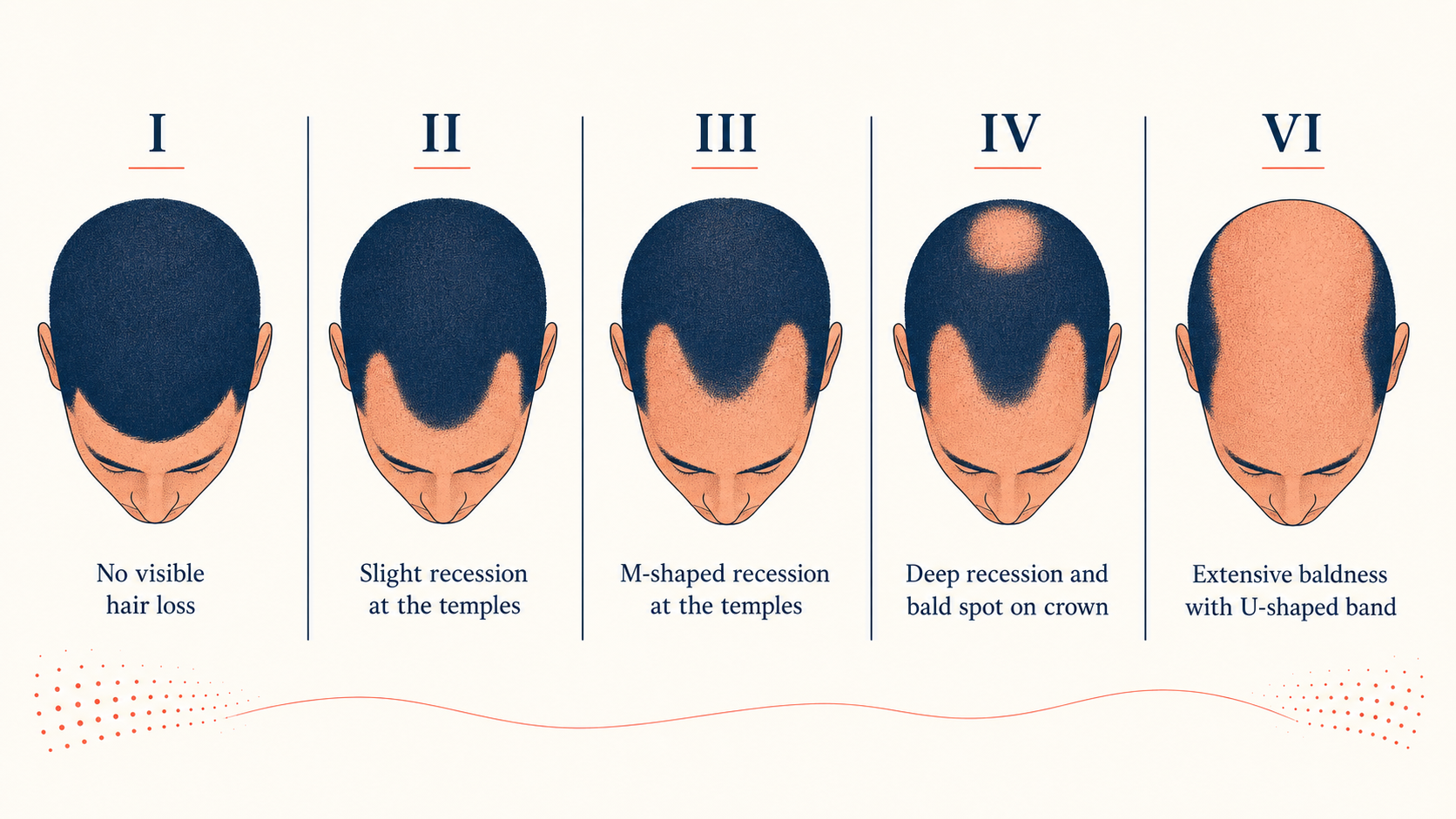
The Hair Growth Cycle: How DHT Disrupts It
The anagen, catagen, telogen cycle
Every scalp hair follicle cycles through three phases. Anagen is the active growth phase, lasting 2 to 7 years and determining how long hair can grow before it sheds. Catagen is a brief transitional phase, lasting 2 to 3 weeks, during which the follicle regresses. Telogen is the resting phase, lasting roughly 3 months, after which the hair sheds and a new anagen phase begins. At any given time, about 85 to 90 percent of scalp follicles are in anagen and 10 to 15 percent are in telogen, which is why losing 50 to 100 hairs a day is entirely normal.
Follicle miniaturization
In androgenetic alopecia, DHT progressively shortens the anagen phase with each successive cycle while the telogen phase stays roughly the same length or lengthens slightly. Over repeated cycles, this shifts the ratio toward more resting follicles and less active growth time per cycle. The follicle itself also physically shrinks, producing thinner, shorter, lighter-colored (less pigmented) hairs called vellus-like hairs in place of the thick, pigmented terminal hairs the follicle once produced.[1] This is why male pattern hair loss looks like gradual thinning rather than sudden patchy loss. The follicles are not dying outright, at least not early on, they are shrinking and producing progressively weaker hairs until, eventually, some stop producing visible hair altogether.
This mechanism has a direct treatment implication: because miniaturization is at least partly reversible in its earlier stages, treatments that block DHT (finasteride, dutasteride) or that extend anagen and improve follicular blood flow (minoxidil) can partially reverse miniaturization and restore some terminal hair growth, but only in follicles that have not yet been miniaturized beyond the point of recovery. This is also why earlier treatment tends to produce better results than treatment started after years of untreated progression.
What's Changed in 2024 to 2026
Male pattern hair loss management has moved meaningfully in the past two to three years, with a formal practice guideline update, growing mainstream acceptance of a previously niche approach, and incremental progress on the drug pipeline.
AAD 2024 guidelines finalized. The American Academy of Dermatology published an updated guideline of care for androgenetic alopecia in 2024, reaffirming oral finasteride and topical minoxidil as first-line pharmacologic therapy and, notably, formally acknowledging low-dose oral minoxidil as a reasonable option for appropriate candidates, a shift from earlier guidance that treated oral minoxidil purely as an antihypertensive with hair growth as an incidental side effect.[1]
Low-dose oral minoxidil goes mainstream. What began as an off-label, dermatologist-driven workaround for patients who could not tolerate or comply with topical minoxidil has become a standard alternative offered from the first visit in many practices, including via telehealth. Larger case series and open-label trials published since 2020 have solidified the efficacy and safety data at doses well below those used for blood pressure control.[4][5]
Topical finasteride phase 3 completion. A phase 3, randomized, controlled trial of a topical finasteride spray solution reported efficacy comparable to oral finasteride with substantially lower systemic absorption, and therefore a theoretically lower risk of systemic sexual side effects.[9] Topical finasteride is not yet FDA-approved as a standalone product in the US but is available through compounding pharmacies and has grown in popularity among men specifically trying to minimize systemic exposure.
Emerging: prostaglandin D2 antagonists and PP-405. Prostaglandin D2 (PGD2) has been identified as a mediator that inhibits hair growth in balding scalp, and PGD2 receptor antagonists are in early clinical development as a novel, non-hormonal mechanism distinct from DHT blockade. Separately, PP-405, a small molecule that activates a metabolic pathway to stimulate hair follicle stem cells, has entered early-phase trials. Neither is FDA-approved as of 2026, and patients should be cautious of any product marketed based on these mechanisms outside of a registered clinical trial.
Taken together, the treatment ladder has not fundamentally changed, finasteride and topical minoxidil remain first-line, but oral minoxidil has moved from a niche option to a mainstream alternative or add-on, and the pipeline for genuinely new mechanisms remains early-stage.
Decision Framework: How to Choose a Treatment
Treatment choice depends on Norwood-Hamilton stage, tolerance for oral versus topical medication, cost, and how a patient weighs efficacy against side-effect risk. The table below maps stage to the standard treatment approach used in clinical practice.[1]
| Norwood Scale | Description | Best treatment approach |
|---|---|---|
| I | Adolescent hairline, no loss | No treatment needed |
| II | Slight recession at temples | Consider early finasteride if progressive |
| III | Deeper temporal recession (widow's peak) | Finasteride + topical minoxidil |
| III vertex | Recession + crown thinning | Combination therapy; monitor at 6 months |
| IV | Frontal recession + notable crown loss | Combination therapy; consider dutasteride if inadequate response |
| V | Broader baldness with bridge of hair | Combination therapy; hair transplant candidate |
| VI to VII | Extensive baldness | Combination therapy; hair transplant is primary option |
Two principles guide almost every decision within this framework. First, earlier treatment produces better results, because follicles that have not yet miniaturized beyond a certain point are more responsive to DHT blockade and minoxidil than follicles that have been shrinking for years. Second, combination therapy is the standard of care for any stage beyond the earliest recession, not an escalation reserved for treatment failures.
For most men beyond the earliest stages of recession, starting finasteride and topical minoxidil together, rather than trying one, waiting months, and adding the other later, produces better and faster results. Combination therapy achieves stabilization or visible improvement in approximately 90 percent of men at 12 months, compared with roughly 50 to 65 percent for either drug alone.[3]
Side effect frequency by medication
| Side effect | Finasteride 1 mg | Topical minoxidil 5% | Oral minoxidil 2.5-5 mg |
|---|---|---|---|
| Decreased libido | ~2% | 0% | 0% |
| Erectile dysfunction | ~1.3% | 0% | 0% |
| Ejaculation disorder | ~1% | 0% | 0% |
| Scalp irritation | 0% | ~5% | 0% |
| Facial or body hair growth (hypertrichosis) | 0% | ~3% | ~15-25% |
| Transient shedding ("dread shed") | Rare | ~15% in first 6 weeks | ~10% in first 6 weeks |
| Fluid retention or peripheral edema | 0% | Rare | ~3-5% at higher doses |
| Postural hypotension | 0% | Rare | Rare at low doses |
Side effect frequency in pivotal trials and long-term follow-up.[2][4]
Finasteride: The First-Line Standard
How finasteride works
Finasteride is a selective inhibitor of type II 5-alpha reductase, the enzyme that converts testosterone to DHT. By blocking this conversion, finasteride reduces scalp and serum DHT levels by roughly 60 to 70 percent, removing the primary hormonal driver of follicle miniaturization.[2] It does not regrow hair in follicles that have already been permanently lost (no visible follicle remaining), but it can restore terminal hair production in follicles that are miniaturized but still viable, and it reliably slows or halts further progression in the majority of men who take it consistently.
Efficacy: long-term data
The pivotal trial establishing finasteride's efficacy, a multicenter, double-blind, placebo-controlled study of 1 mg daily in men with mild to moderate androgenetic alopecia, found significantly increased hair counts and investigator-rated improvement at 12 months compared with placebo, with continued benefit through 2 years of follow-up.[2] Longer-term data extending to 5 and 10 years of continuous use found that the large majority of men maintained hair count above their pre-treatment baseline, and that long-term use decreased the likelihood of developing further visible hair loss compared with what would be expected with no treatment.[7] In practical terms, roughly 65 percent of men see a meaningful clinical response, defined as visible regrowth or a clear halt in progression.
Side effects: what's real and what's rare
Finasteride's most discussed side effects are sexual: decreased libido in roughly 2 percent of users, erectile dysfunction in roughly 1.3 percent, and ejaculatory disorders (reduced volume) in roughly 1 percent, based on pooled data from clinical trials.[2] These rates are only modestly above placebo in most trials, and the majority of men who experience side effects find they resolve with continued use or resolve promptly after stopping the medication. Other reported effects include mild breast tenderness or enlargement (gynecomastia) in a small minority, and depression has been raised as a possible association in some observational data, though causation is not firmly established and the absolute risk, if real, appears low.
Post-finasteride syndrome: what the evidence shows
A subset of men report persistent sexual, neurological, or psychological symptoms that continue after stopping finasteride, sometimes termed post-finasteride syndrome. This remains a genuinely contested area. It is not currently a formally recognized diagnosis in DSM or ICD classification systems, existing evidence is largely limited to case reports, patient registries, and small observational studies rather than controlled trials, and proposed mechanisms (persistent epigenetic changes in androgen receptor signaling, neurosteroid alterations) remain unproven.[14] At the same time, the reports are consistent enough across a meaningful number of patients that they should not be dismissed outright. The most defensible clinical position is that persistent post-discontinuation symptoms appear to be uncommon, the overall evidence quality is low, and any patient considering finasteride deserves a candid conversation about this uncertainty rather than either reassurance that it is impossible or alarm that it is common.
Topical Minoxidil: The OTC Foundation
5% vs 2% concentration
Minoxidil was originally developed as an oral antihypertensive; hair growth was an incidental effect discovered during use, which led to development of the topical formulation for androgenetic alopecia. Topical minoxidil is available over the counter in 2% and 5% solutions, plus a 5% foam. A randomized trial comparing the two concentrations directly found 5% minoxidil produced significantly greater hair count increase than 2% minoxidil, with both outperforming placebo, at the cost of a modestly higher rate of local scalp irritation with the 5% formulation.[8] The 5% concentration is now the standard recommendation for men; the 2% formulation is largely retained for use in women, in whom higher concentrations more often cause unwanted facial hypertrichosis.
Application protocol
Standard dosing is 1 mL applied directly to the affected scalp twice daily, morning and evening, massaged in and left to dry before styling products or lying down on a pillow. Consistency matters more than almost any other variable in topical minoxidil's real-world effectiveness: because its mechanism (discussed below) depends on maintaining local drug levels, missed applications reduce the benefit disproportionately relative to how minor a missed dose might seem.
The transient dread shed
Many men experience an increase in shedding during the first 2 to 8 weeks of minoxidil use, colloquially called the "dread shed." This occurs because minoxidil pushes resting (telogen) follicles into the growth (anagen) phase more quickly, which requires shedding the old resting hair first to make way for a new growth cycle. This shed is not a sign of treatment failure or worsening hair loss, it is a sign the medication is working, and it typically resolves within 2 to 6 weeks as new anagen hairs begin to grow in.[1] Setting this expectation before starting treatment prevents the single most common reason men discontinue minoxidil prematurely.
Any hair regained through finasteride or minoxidil, oral or topical, is maintained only with continued use. Stopping either medication leads to gradual loss of the gained benefit over approximately 6 to 12 months, ultimately returning the scalp to roughly where it would have been without treatment.[1] Patients should understand this before starting: these are maintenance therapies, not one-time cures.
Oral Minoxidil (Low-Dose): The Emerging Option
Why oral minoxidil for hair loss
Oral minoxidil at low doses, well below the doses used historically for resistant hypertension, has become a popular option for men who find topical application inconvenient, cosmetically unappealing (residue, hair texture changes), or insufficiently effective. Because it is taken systemically rather than applied to the scalp, it reaches all follicles uniformly and does not depend on correct topical application technique, which likely contributes to its comparatively high response rate in observational data.[5]
Dosing: 0.25 to 5 mg daily
Typical dosing for androgenetic alopecia ranges from 0.25 mg to 5 mg once daily, substantially below the 10 to 40 mg or higher doses used for blood pressure indications. An open-label study of 5 mg oral minoxidil once daily in men with androgenetic alopecia found significant improvement in hair density by global photographic assessment at 24 weeks, with a favorable safety profile at this dose.[4] Many clinicians start lower, at 1.25 or 2.5 mg, and titrate upward based on tolerability and response.
Side effects: hypertrichosis, transient edema
The most common side effect is hypertrichosis, increased fine hair growth on the face and body, occurring in roughly 15 to 25 percent of users at these doses, more common in women than men but still relevant to men concerned about facial hair changes.[11] Fluid retention or mild peripheral edema, particularly ankle swelling, occurs in a smaller percentage, generally at higher doses within the low-dose range, and typically resolves with dose reduction.[5] These effects, along with other dermatologic reactions occasionally seen with minoxidil more broadly, have been catalogued in reviews of the drug's side-effect profile across formulations.[12]
Cardiovascular considerations
Because minoxidil is a vasodilator, it can cause reflex tachycardia and, less commonly, symptomatic hypotension, particularly at higher end doses or in patients also taking antihypertensive medications. Patients with a history of heart failure, pericardial effusion, or significant cardiovascular disease need a cardiology-informed risk discussion before starting oral minoxidil, and clinicians should ask about baseline blood pressure and resting heart rate before prescribing.[10] For most healthy men without cardiovascular disease, low-dose oral minoxidil is well tolerated, but it is not a decision to make casually for a cosmetic indication without at least a basic cardiovascular history.
Dutasteride: The Stronger 5-Alpha Reductase Inhibitor
Dutasteride inhibits both type I and type II 5-alpha reductase, compared with finasteride's selective type II inhibition, and produces a substantially greater reduction in serum DHT, often cited around 90 percent versus finasteride's 60 to 70 percent. It is FDA-approved in the United States only for benign prostatic hyperplasia, not for hair loss, but is FDA-approved for androgenetic alopecia in South Korea and Japan and is prescribed off-label for hair loss in the US, typically at 0.5 mg daily.[1]
A randomized trial in men who had an inadequate response to finasteride found that switching to dutasteride 0.5 mg daily produced significant additional improvement in hair density, suggesting dutasteride can be effective in a subset of finasteride non-responders, likely reflecting the contribution of type I 5-alpha reductase activity in some men's follicles.[6] Because dutasteride has a much longer half-life than finasteride (weeks versus about 6 to 8 hours), any side effects, sexual or otherwise, also take longer to resolve after discontinuation, which is a relevant consideration when counseling patients before they start. Notably, 5-alpha reductase inhibitors are not limited to men: case data in postmenopausal women with patterned hair loss and normal androgen levels has also shown a response to finasteride, underscoring that the DHT pathway, while central to male pattern hair loss, is not exclusively a male phenomenon.[13]
Combination Therapy: When One Isn't Enough
Because finasteride (or dutasteride) and minoxidil act through different mechanisms, DHT suppression versus direct stimulation of follicular growth and blood flow, combining them produces additive benefit rather than simply duplicating effect. This is the single most consistent finding across the male pattern hair loss literature: combination therapy outperforms either monotherapy on essentially every outcome measure that has been studied.[3]
| Medication | Route | Typical dose | Time to visible effect | Response rate | 2026 monthly cost | Prescription needed? |
|---|---|---|---|---|---|---|
| Finasteride | Oral | 1 mg daily | 6 to 12 months | ~65% | $10 to $30 generic | Yes |
| Topical minoxidil 5% | Topical | 1 mL twice daily | 3 to 6 months | ~50% | $15 to $30 (OTC) | No |
| Oral minoxidil (low-dose) | Oral | 2.5 to 5 mg daily | 3 to 6 months | ~78% | $10 to $30 generic | Yes (off-label) |
| Dutasteride | Oral | 0.5 mg daily | 6 to 12 months | ~70% | $20 to $40 generic | Yes (off-label in US) |
| Finasteride + topical minoxidil | Combination | Per above | 6 to 12 months | ~90% | $25 to $60 combined | Yes (finasteride) |
| Topical finasteride | Topical | 0.25% solution, 100 mcL daily | 6 to 12 months | ~55% | $50 to $80 compounded | Yes (compounded) |
Some men substitute low-dose oral minoxidil for the topical formulation within this combination, pairing it with finasteride or dutasteride, trading the inconvenience of twice-daily topical application for the systemic side-effect profile of an oral vasodilator. Either combination (oral 5-alpha reductase inhibitor plus topical minoxidil, or oral 5-alpha reductase inhibitor plus low-dose oral minoxidil) is reasonable; the choice generally comes down to which side-effect profile and dosing routine a given patient prefers.
Platelet-Rich Plasma (PRP) and Adjuncts
PRP evidence
Platelet-rich plasma involves drawing a patient's own blood, concentrating the platelet-rich fraction by centrifugation, and injecting it into the scalp, on the theory that growth factors released by activated platelets stimulate follicular stem cells and improve local blood supply. Evidence quality varies considerably across studies, with meaningful differences in preparation protocols, injection technique, and number of sessions between trials, making cross-study comparison difficult. Where benefit is seen, it is generally modest and works best as an adjunct to finasteride and minoxidil rather than a standalone therapy. PRP typically requires a series of 3 to 6 monthly sessions followed by maintenance treatments, at a cash cost of several hundred dollars per session, which is a meaningful factor in whether it is a reasonable addition for a given patient.
Low-level laser therapy
Low-level laser therapy (LLLT) devices, available as combs, helmets, and caps, are FDA-cleared for androgenetic alopecia based on modest improvements in hair density in clinical trials, thought to work through photobiomodulation effects on follicular mitochondrial activity. Effect sizes are generally smaller than finasteride or minoxidil, and LLLT is best considered a low-risk adjunct rather than a primary treatment.
Microneedling
Microneedling, creating controlled microscopic injury to the scalp with a fine-needle roller or pen device, is theorized to stimulate wound-healing growth factor release and may improve topical minoxidil penetration when combined with it. Small trials suggest a modest additive benefit when microneedling is combined with topical minoxidil compared with minoxidil alone, though study sizes are small and protocols vary.
Hair Transplantation: When Medical Therapy Isn't Enough
FUE vs FUT
Hair transplantation relocates follicles from DHT-resistant donor zones (typically the back and sides of the scalp) to balding areas. Follicular unit extraction (FUE) removes individual follicular units directly with a small punch tool, leaving small scattered scars rather than a single linear scar. Follicular unit transplantation (FUT), the older strip method, removes a strip of donor scalp and dissects it into individual grafts under magnification, leaving a single linear donor scar but often allowing a greater total graft yield in a single session. Both are legitimate techniques; the choice often comes down to donor scar preference, total grafts needed, and surgeon expertise.
When to consider
Transplantation is a reasonable option for men with stable, well-defined areas of loss (typically Norwood IV and beyond) who have realistic expectations about donor supply limitations, and it works best in conjunction with, not instead of, ongoing medical therapy. Transplanted hair is DHT-resistant because it retains the biology of its donor site, but the native, non-transplanted hair surrounding a transplant remains susceptible to ongoing DHT-driven loss unless medical therapy continues. Skipping medical therapy after a transplant risks an uneven, patchy result over time as untreated native hair around the graft continues to thin.
Cost and expectations
Cost varies widely by geography, technique, and number of grafts, generally ranging from several thousand to well over ten thousand dollars for larger sessions. Full results take 9 to 12 months to mature, since transplanted follicles go through a shedding phase (similar in concept, though unrelated in cause, to the minoxidil dread shed) before regrowing in their new location. Realistic candidacy assessment, adequate donor density, appropriate expectations about graft survival, and commitment to continued medical therapy, matters more to a good long-term outcome than the specific technique chosen.
Contraindications and Safety
Finasteride and pregnancy: never touch broken pills
Finasteride is contraindicated for use by pregnant women and, critically, women who are or may become pregnant should not handle broken or crushed finasteride tablets, because the drug can be absorbed through the skin and, given its mechanism of blocking DHT production, poses a risk of abnormal genital development in a male fetus. Intact, coated tablets are safe to handle. This is a real, well-documented risk, not a theoretical warning, and it should be discussed clearly with any patient whose household includes a partner who is or might become pregnant.[2]
Women who are pregnant or may become pregnant should never handle broken or crushed finasteride or dutasteride tablets. Skin absorption of these drugs can affect normal genital development in a male fetus. Intact, film-coated tablets are safe to handle and pass to a patient.
Minoxidil cardiovascular precautions
Topical minoxidil has low systemic absorption and is generally considered safe even for men with cardiovascular disease, though it should be discontinued if significant unexplained weight gain, chest pain, or rapid heartbeat develops. Oral minoxidil carries more meaningful cardiovascular considerations given its systemic vasodilating effect, discussed above, and warrants a baseline blood pressure and heart rate check plus caution in men with heart failure, pericardial disease, or poorly controlled hypertension.[10]
Drug interactions
Finasteride and dutasteride have relatively few clinically significant drug interactions, though both can modestly affect prostate-specific antigen (PSA) levels (roughly halving them), which is relevant for any man also undergoing prostate cancer screening, since a clinician needs to double the reported PSA value to correctly interpret it. Oral minoxidil should be used cautiously alongside other antihypertensive medications, given additive blood pressure-lowering effects, and men on guanethidine (rarely used today) should avoid oral minoxidil due to a specific interaction risk.
What Doesn't Work: Supplements, "Hair Growth Shampoos," and Marketing Claims
The hair loss market is heavily populated with products that have little to no supporting evidence, and separating them from evidence-based treatment matters both for outcomes and for a patient's wallet.
- Biotin supplements: effective only for the rare patient with an actual biotin deficiency, which is uncommon in men eating a normal diet; there is no credible evidence biotin regrows hair in men with normal biotin levels and androgenetic alopecia
- "Hair growth" shampoos and topical cosmetic serums (non-minoxidil): may improve hair's cosmetic appearance (shine, thickness of the shaft) but do not affect the underlying miniaturization process driving androgenetic alopecia
- Saw palmetto: has weak, inconsistent evidence for a mild 5-alpha reductase inhibiting effect; any benefit is substantially smaller than finasteride or dutasteride and should not be relied on as a primary treatment
- Ketoconazole shampoo: may offer a small adjunctive benefit, possibly through mild anti-androgenic and anti-inflammatory scalp effects, but has not been shown to be an effective standalone treatment
- Essential oils and scalp massage devices marketed for hair regrowth: lack rigorous trial evidence; scalp massage alone has weak evidence for small effects and is not a substitute for medical therapy
- "Clinically proven" over-the-counter products without FDA-reviewed minoxidil: often rely on marketing language borrowing credibility from minoxidil's actual evidence base without containing an active ingredient with comparable data
The pattern across nearly all of these is the same: plausible-sounding mechanism, weak or absent trial evidence, and a price point that assumes the buyer will not ask for the data. Finasteride, minoxidil (topical or oral), and dutasteride have decades of trial evidence behind them and, notably, are also among the least expensive options on this list.
Red Flags: When Hair Loss Is Not Male Pattern
Most hair thinning in adult men is androgenetic alopecia, but certain presentations should prompt evaluation for an alternative diagnosis before defaulting to a male pattern hair loss treatment plan:
- Patchy, well-circumscribed bald spots rather than diffuse thinning at the temples and crown, which suggests alopecia areata, an autoimmune condition with a different treatment approach entirely
- Scalp itching, burning, scaling, redness, or pustules at the site of hair loss, which suggests an inflammatory or infectious scalp condition (seborrheic dermatitis, tinea capitis, folliculitis, or a scarring alopecia) requiring dermatologic evaluation and possibly biopsy
- Rapid, diffuse shedding over weeks rather than gradual thinning over years, which is more consistent with telogen effluvium, often triggered by illness, surgery, significant weight loss, medication changes, or major stress 2 to 3 months prior
- Hair loss with systemic symptoms such as fatigue, weight change, or menstrual irregularity in a partner (if evaluating for a family or genetic pattern), which can suggest thyroid disease or another endocrine cause worth screening for
- Hair loss beginning before puberty or an unusual pattern (eyebrows, eyelashes, body hair) alongside scalp loss, which warrants evaluation for a different underlying cause
- Scarring or shiny, smooth patches of scalp skin where hair once was, which suggests a scarring (cicatricial) alopecia and is a dermatologic urgency, since scarring alopecias cause permanent follicle destruction and benefit most from early treatment
Androgenetic alopecia has a hallmark pattern (temporal recession and/or crown thinning, gradual onset over years, family history, no associated scalp inflammation or systemic symptoms) that most experienced clinicians can recognize on a good history and scalp exam alone. Any significant deviation from that pattern is reason to pursue a broader diagnostic evaluation rather than starting finasteride and minoxidil by default.
Frequently Asked Questions
Yes. Finasteride 1 mg daily blocks the enzyme that converts testosterone to DHT, reducing scalp DHT by roughly 60 to 70 percent, and produces a meaningful clinical response, visible regrowth or halted progression, in about 65 percent of men.[2] Long-term data through 5 and 10 years shows most men who continue taking it maintain hair count above their pre-treatment baseline.[7]
Most men need 3 to 6 months before noticing reduced shedding, and 6 to 12 months before visible density improvement becomes apparent to themselves or others. Continued improvement can occur through 24 months of consistent use.[4] Photos taken at the same angle and lighting every few months are more reliable than day-to-day mirror checks for tracking real change.
To maintain results, yes. Finasteride and minoxidil (topical or oral) are maintenance therapies, not one-time cures. Stopping either leads to gradual loss of gained benefit over about 6 to 12 months, ultimately returning the scalp to roughly where it would have been without treatment.[1]
Pooled trial data show decreased libido in about 2 percent of users, erectile dysfunction in about 1.3 percent, and ejaculatory disorders in about 1 percent, only modestly above placebo rates in most trials.[2] Most men who experience these effects find they resolve with continued use or resolve promptly after stopping the medication.
A subset of men report persistent sexual, neurological, or psychological symptoms after stopping finasteride. It is not a formally recognized diagnosis, and existing evidence is limited to case reports, patient registries, and small observational studies rather than controlled trials, so causation is not established.[14] The most defensible position is that persistent post-discontinuation symptoms appear uncommon, evidence quality is low, and this uncertainty deserves a candid conversation before starting treatment.
At low doses (0.25 to 5 mg daily), oral minoxidil has a favorable safety profile in most healthy men and, in open-label data, produces response rates around 78 percent, higher than topical minoxidil's roughly 50 percent, likely because it reaches all follicles uniformly without depending on application technique.[4][5] Hypertrichosis (extra facial and body hair) and mild fluid retention are the main trade-offs, and men with significant cardiovascular disease need a risk discussion before starting.
The dread shed is a temporary increase in hair shedding during the first 2 to 8 weeks of minoxidil use, caused by resting follicles being pushed into a new growth phase, which requires shedding the old hair first.[1] It typically resolves within 2 to 6 weeks and is a sign the medication is working, not a sign of worsening hair loss.
Transplantation is a reasonable option for men with stable, well-defined loss, typically Norwood IV and beyond, who have realistic expectations about donor supply. It works best alongside, not instead of, ongoing medical therapy, since native hair around a transplant remains susceptible to DHT-driven loss without continued treatment. Full results take 9 to 12 months to mature.
Generally, no. Biotin only helps in the rare case of an actual biotin deficiency. "Hair growth" shampoos and cosmetic serums may improve the hair shaft's appearance but do not address the follicle miniaturization driving androgenetic alopecia. Finasteride, minoxidil, and dutasteride have decades of trial evidence behind them and are also among the least expensive options on the market.
Yes. A licensed clinician can review medical history, including cardiovascular and psychiatric history, and prescribe oral finasteride, topical minoxidil, oral minoxidil, or dutasteride through a synchronous telehealth visit in all 50 states. Procedures such as PRP injections and hair transplantation require an in-person visit.
Finasteride selectively inhibits type II 5-alpha reductase; dutasteride inhibits both type I and type II, producing a greater reduction in serum DHT (roughly 90 percent versus 60 to 70 percent).[1] Dutasteride is FDA-approved for hair loss in South Korea and Japan but only for benign prostatic hyperplasia in the US, where it is used off-label for hair loss, often in men who had an inadequate response to finasteride.[6] Its longer half-life also means side effects take longer to resolve after stopping.
Patchy, well-circumscribed bald spots, scalp itching or scaling, rapid shedding over just a few weeks, scarring or shiny bald patches, and hair loss beginning before puberty are not typical of androgenetic alopecia and warrant evaluation for an alternative diagnosis such as alopecia areata, a scalp infection, telogen effluvium, or a scarring alopecia before defaulting to a male pattern hair loss treatment plan.
References
- Kanti V, Messenger A, Dobos G, et al. Evidence-based (S3) guideline for the treatment of androgenetic alopecia in women and in men, short version. J Eur Acad Dermatol Venereol. 2018;32(1):11-22. Full text
- Kaufman KD, Olsen EA, Whiting D, et al. Finasteride in the treatment of men with androgenetic alopecia. Finasteride Male Pattern Hair Loss Study Group. J Am Acad Dermatol. 1998;39(4 Pt 1):578-589. Full text
- Olsen EA, Weiner MS, Amara IA, DeLong ER. Five-year follow-up of men with androgenetic alopecia treated with topical minoxidil. J Am Acad Dermatol. 1990;22(4):643-646. Full text
- Panchaprateep R, Lueangarun S. Efficacy and Safety of Oral Minoxidil 5 mg Once Daily in the Treatment of Male Patients with Androgenetic Alopecia: An Open-Label and Global Photographic Assessment. Dermatol Ther (Heidelb). 2020;10(6):1345-1357. Full text
- Randolph M, Tosti A. Oral minoxidil treatment for hair loss: A review of efficacy and safety. J Am Acad Dermatol. 2021;84(3):737-746. Full text
- Jung JY, Yeon JH, Choi JW, et al. Effect of dutasteride 0.5 mg/d in men with androgenetic alopecia recalcitrant to finasteride. Int J Dermatol. 2014;53(11):1351-1357. Full text
- Kaufman KD, Rotonda J, Shah AK, Meehan AG. Long-term treatment with finasteride 1 mg decreases the likelihood of developing further visible hair loss in men with androgenetic alopecia. Eur J Dermatol. 2008;18(4):400-406. Full text
- Olsen EA, Dunlap FE, Funicella T, et al. A randomized clinical trial of 5% topical minoxidil versus 2% topical minoxidil and placebo in the treatment of androgenetic alopecia in men. J Am Acad Dermatol. 2002;47(3):377-385. Full text
- Piraccini BM, Blume-Peytavi U, Scarci F, et al. Efficacy and safety of topical finasteride spray solution for male androgenetic alopecia: a phase III, randomized, controlled clinical trial. J Eur Acad Dermatol Venereol. 2022;36(2):286-294. Full text
- Gupta AK, Wang T, Polla Ravi S, Bamimore MA, Piguet V, Tosti A. Systematic review of newer agents for the management of alopecia areata in adults: Janus kinase inhibitors, biologics and phosphodiesterase-4 inhibitors. J Eur Acad Dermatol Venereol. 2023;37(4):666-679. Full text
- Sinclair R. Female pattern hair loss: a pilot study investigating combination therapy with low-dose oral minoxidil and spironolactone. Int J Dermatol. 2018;57(1):104-109. Full text
- Rossi A, Cantisani C, Melis L, et al. Minoxidil use in dermatology, side effects and recent patents. Recent Pat Inflamm Allergy Drug Discov. 2012;6(2):130-136. Full text
- Trueb RM. Finasteride treatment of patterned hair loss in normoandrogenic postmenopausal women. Dermatology. 2004;209(3):202-207. Full text
- Traish AM. Post-finasteride syndrome: a surmountable challenge for clinicians. Fertil Steril. 2020;113(1):21-50. Full text