Key Takeaways
- The classic triad of burning with urination, urgency, and frequency points to a bladder infection with more than 90% accuracy in premenopausal women who have no vaginal discharge or irritation.[1]
- Itching, a thick white discharge, or a fishy odor usually points to a yeast infection or bacterial vaginosis, not a UTI.[9][11]
- New burning with discharge or pelvic symptoms after sex can be chlamydia or gonorrhea, which need STI testing rather than a routine UTI workup.[11]
- Women get UTIs far more often than men because the urethra is short and sits close to the rectum.[3][5]
- First-line antibiotics for uncomplicated cystitis include nitrofurantoin, trimethoprim-sulfamethoxazole, and fosfomycin.[2]
- Fever, flank pain, nausea, or vomiting can mean the infection has reached the kidneys and needs urgent care.[2]
- If you are pregnant, contact your OB or an in-person clinician promptly; UTIs in pregnancy need different evaluation.[2][6]
What Are the First Signs of a UTI in Women?
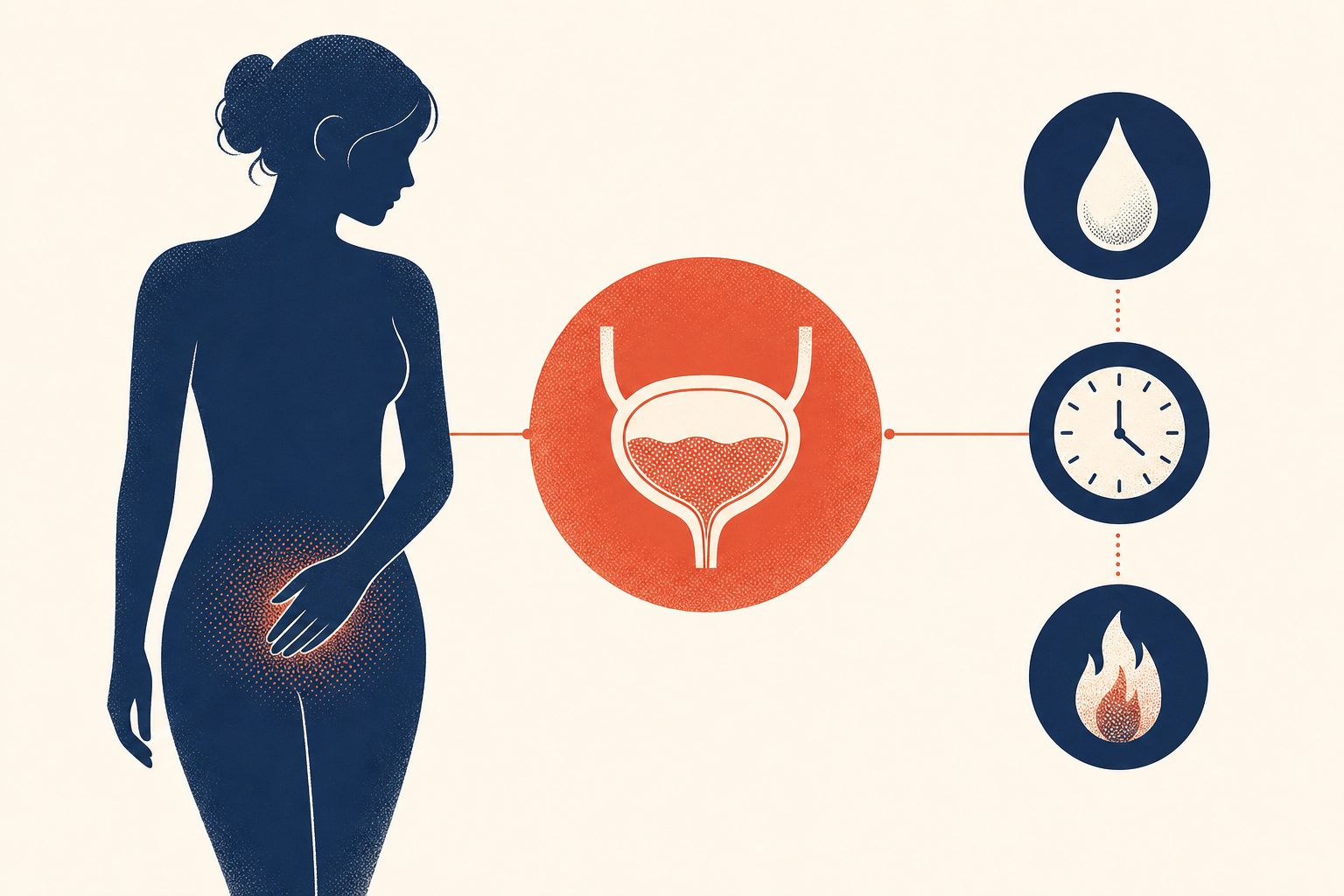
A urinary tract infection, or UTI, usually starts in the bladder, where it is called cystitis. The most common early signs are dysuria (pain or burning when you urinate), urgency (a sudden, hard-to-ignore need to go), and frequency (needing to urinate more often than usual, often with only small amounts each time).[3][4]
These three symptoms are so characteristic that, in a premenopausal woman who has no vaginal discharge or irritation, they predict a bladder infection with more than 90% accuracy. That estimate comes from a landmark JAMA review by Bent and colleagues, which pooled studies of how well symptoms predict acute uncomplicated cystitis.[1]
Other signs can appear alongside the triad. Urine may look cloudy or have a stronger smell than usual, and a small amount of blood may make it pink or red. Some women feel pressure, heaviness, or mild discomfort low in the pelvis, just above the pubic bone. These symptoms are common but are not as specific as the classic triad on their own.[4][8]
What matters most for the next step is what is not there. Vaginal discharge, itching, or irritation pushes the picture away from a simple bladder infection and toward a vaginal or sexually transmitted cause, which changes both testing and treatment.[1][11]
What Does a UTI Feel Like vs a Yeast Infection?
A UTI and a vaginal yeast infection (vulvovaginal candidiasis) both cause burning, but they feel different and point to different treatments. A UTI centers on urination: pain or burning while you urinate, urgency, and frequency, with little or no vaginal discharge. A yeast infection centers on the vulva and vagina: itching, soreness, and a thick, white, cottage-cheese-like discharge, with little or no change in how often you urinate.[9]
The overlap is real, and some women have both at once, especially after a course of antibiotics. Antibiotics used to treat a UTI can clear protective vaginal bacteria and allow yeast to overgrow, so a yeast infection can start a few days after UTI treatment.[9]
| Symptom | UTI (cystitis) | Yeast infection |
|---|---|---|
| Pain or burning with urination | Common, central symptom | May burn when urine touches irritated skin |
| Urgency and frequency | Common | Usually absent |
| Vaginal discharge | Usually none | Thick, white, cottage-cheese-like |
| Itching | Usually absent | Common, often intense |
| Odor | Urine may smell stronger | Usually no strong odor |
| Location of discomfort | Bladder and urethra, low pelvis | Vulva and vagina |
Because the treatments are different, it is worth getting the right diagnosis rather than guessing. Antifungal treatment will not help a bacterial UTI, and antibiotics will not help a yeast infection and may make it worse.[9]
UTI vs Bacterial Vaginosis: How to Tell
Bacterial vaginosis (BV) is an overgrowth of certain bacteria in the vagina, not an infection of the urinary tract. Its hallmark is a thin, gray-white vaginal discharge with a fishy odor, often more noticeable after sex. BV typically does not cause burning with urination, urgency, or frequency the way a UTI does, although the discharge can cause mild irritation.[11]
The key difference is the discharge. A UTI rarely causes vaginal discharge at all, while BV is defined by it. If you have a thin, fishy-smelling discharge, the problem is likely vaginal and should be evaluated as BV rather than treated as a bladder infection.[11]
Both can occur together, and both are common in sexually active women. The CDC STI Treatment Guidelines describe BV as the most common vaginal condition in women of reproductive age, which is why a clinician will ask about discharge, odor, and sexual history when urinary symptoms are present.[11]
Can an STI Feel Like a UTI?
Yes. Chlamydia and gonorrhea can infect the urethra and cause dysuria, or burning with urination, that feels very much like a UTI. When the infection also involves the cervix, a woman may notice vaginal discharge, bleeding between periods, or pelvic pain, which are not typical of a simple bladder infection.[11]
Several clues point toward an STI rather than a UTI: a new or multiple sexual partners, a partner with symptoms, discharge from the urethra or vagina, pelvic pain, or symptoms that started shortly after sex. In these situations, testing for chlamydia and gonorrhea is appropriate, and treatment should target the specific organism rather than assuming a routine bladder infection.[11]
| Feature | UTI (cystitis) | Chlamydia or gonorrhea |
|---|---|---|
| Main symptom | Burning, urgency, frequency | Burning, sometimes with discharge |
| Vaginal discharge | Usually none | May be present |
| Urgency and frequency | Common | Less common |
| Pelvic pain or bleeding between periods | Uncommon | Possible with cervical infection |
| Typical trigger | Recent sexual activity, anatomy | New or untreated partner |
| Testing needed | Urinalysis, sometimes culture | Nucleic acid test for chlamydia and gonorrhea |
Because the treatments differ completely, getting the right test matters. The CDC recommends nucleic acid amplification testing for chlamydia and gonorrhea when an STI is suspected, and routine UTI antibiotics do not reliably cure these infections.[11]
Why Do Women Get UTIs More Often Than Men?
Anatomy is the main reason. In women, the urethra, the tube that carries urine out of the body, is short and opens close to the rectum. Bacteria from the gut, most often Escherichia coli, can reach the bladder more easily than in men, whose longer urethra puts the bladder farther from the skin and the rectum.[3][5]
Sexual activity is the strongest behavioral risk factor, because it can push bacteria toward the urethra. Other factors include a history of prior UTIs, use of spermicides or a diaphragm, and, after menopause, lower estrogen levels that change the protective environment of the vagina and urethra.[3][5]
The numbers are striking. Roughly half of all women will have at least one UTI in their lifetime, and many will have repeat infections, while UTIs are uncommon in younger men.[5]
When Is It Not a UTI (Interstitial Cystitis, Stones, Irritants)?
Several conditions can cause bladder pain, urgency, and frequency without a bacterial infection. When symptoms linger for weeks, recur without a positive culture, or do not respond to antibiotics, one of these look-alikes may be the real cause.[10]
Interstitial cystitis / bladder pain syndrome (IC/BPS) causes chronic bladder pressure and pain, often with urgency and frequency, but urine cultures stay negative and antibiotics do not help. The American Urological Association guideline describes it as a diagnosis of exclusion, meaning other causes, including infection, must be ruled out first.[10]
Kidney stones can cause pain, blood in the urine, and urinary urgency, sometimes with flank or back pain. Chemical irritants, including bubble baths, scented soaps, douches, spermicides, and some hygiene products, can irritate the urethra and mimic a UTI without any infection. After menopause, thinning of the vaginal and urethral lining, called genitourinary syndrome of menopause, can also cause burning and urgency.[4]
The practical point is that not every burning or urgent bladder is an infection. If symptoms persist or a urine culture is negative, a clinician will look beyond the bladder for these other causes rather than repeating antibiotics.[4][10]
How Is a UTI Diagnosed in Women?
For a healthy, nonpregnant woman with the classic triad and no vaginal symptoms, the diagnosis can often be made from the history alone. The symptoms are that predictive.[1] When the picture is less clear, or when the woman is pregnant, has recurrent infections, or has atypical symptoms, testing adds useful information.[2][4]
A urine dipstick checks for leukocyte esterase (a marker of white blood cells) and nitrite (a byproduct of certain bacteria). These are helpful but imperfect: a positive nitrite supports infection, while a negative dipstick does not reliably rule one out in a symptomatic woman.[8]
A urine culture is the reference test when the organism or its antibiotic sensitivities matter, such as in recurrent infection, treatment failure, pregnancy, or concern for pyelonephritis. A clean-catch midstream sample, collected correctly, gives the most reliable culture result.[7]
What Is the Standard Treatment?
Uncomplicated cystitis in a healthy, nonpregnant woman is treated with a short course of an oral antibiotic. The 2011 IDSA guideline recommends nitrofurantoin, trimethoprim-sulfamethoxazole (TMP-SMX), or fosfomycin as first-line options, with the choice guided by local resistance patterns, allergies, and prior treatment history.[2]
| Antibiotic | Typical course | Notes |
|---|---|---|
| Nitrofurantoin | 5 days | Common first-line choice; minimal effect on gut flora |
| Trimethoprim-sulfamethoxazole | 3 days | Avoid if local E. coli resistance exceeds 20% |
| Fosfomycin | Single dose | One-time oral dose; convenient option |
Fluoroquinolones such as ciprofloxacin are reserved for situations where other options are not suitable, because of concerns about side effects and rising resistance. The full course should be finished as prescribed, even if symptoms improve early.[2]
Symptoms often begin to improve within a day or two of starting antibiotics. If they do not improve within about 48 hours, or if they worsen, contact the prescribing clinician, because the organism may be resistant or the diagnosis may need another look.[2][3]
When Should a Woman See a Doctor for UTI Symptoms?
Most women with a first, uncomplicated UTI should be evaluated so they can get the right antibiotic rather than guessing. Several signs should prompt same-day or urgent care, because they can mean the infection has reached the kidneys or that something more serious is happening.[2]
Get same-day or urgent care if you have fever or chills, flank or upper-back pain, nausea or vomiting, visible blood in the urine, symptoms that do not improve within 48 hours of treatment, or symptoms that keep coming back. If you are pregnant, contact your OB or an in-person clinician promptly; UTIs in pregnancy need different evaluation.[2][6]
Recurrent UTIs, meaning two or more infections in six months or three or more in a year, also deserve a clinician's attention, because prevention strategies and a look for underlying causes may be needed.[2]
Frequently Asked Questions
Burning or pain with urination, a sudden strong need to urinate, and urinating more often. Together these three symptoms predict a bladder infection with more than 90% accuracy in premenopausal women who have no vaginal discharge or irritation.[1]
A UTI causes burning with urination, urgency, and frequency with little or no discharge. A yeast infection causes vulvar itching and a thick, white, cottage-cheese-like discharge, usually without urgency or frequency.[9]
Yes. Chlamydia and gonorrhea can infect the urethra and cause burning with urination. Discharge, pelvic pain, bleeding between periods, or a new partner point toward an STI and warrant specific testing.[11]
Drinking extra fluids and using a bladder-pain reliever can ease discomfort, but these do not cure the infection. A bacterial UTI needs an appropriate antibiotic, so contact a clinician for a treatment decision rather than relying on home remedies alone.[2]
References
- Bent S, Nallamothu BK, Simel DL, Fihn SD, Saint S. Does this woman have an acute uncomplicated urinary tract infection? JAMA. 2002;287(20):2701-2710. PMID: 12020306. https://pubmed.ncbi.nlm.nih.gov/12020306/
- Gupta K, Hooton TM, Naber KG, et al. International clinical practice guidelines for the treatment of acute uncomplicated cystitis and pyelonephritis in women: A 2010 update by the Infectious Diseases Society of America and the European Society for Microbiology and Infectious Diseases. Clin Infect Dis. 2011;52(5):e103-e120. PMID: 21292654. https://pubmed.ncbi.nlm.nih.gov/21292654/
- Hooton TM. Clinical practice. Uncomplicated urinary tract infection. N Engl J Med. 2012;366(11):1028-1037. PMID: 22417256. https://pubmed.ncbi.nlm.nih.gov/22417256/
- Colgan R, Williams M. Diagnosis and treatment of acute uncomplicated cystitis. Am Fam Physician. 2011;84(7):771-776. PMID: 22010614. https://pubmed.ncbi.nlm.nih.gov/22010614/
- Foxman B. Epidemiology of urinary tract infections: incidence, morbidity, and economic costs. Am J Med. 2002;113 Suppl 1A:5S-13S. PMID: 12113866. https://pubmed.ncbi.nlm.nih.gov/12113866/
- Nicolle LE, Gupta K, Bradley SF, et al. Clinical Practice Guideline for the Management of Asymptomatic Bacteriuria: 2019 Update by the Infectious Diseases Society of America. Clin Infect Dis. 2019;68(10):e83-e110. PMID: 30895288. https://pubmed.ncbi.nlm.nih.gov/30895288/
- Hooton TM, Roberts PL, Cox ME, Stapleton AE. Voided midstream urine culture and acute cystitis in premenopausal women. N Engl J Med. 2013;369(20):1883-1891. PMID: 24224622. https://pubmed.ncbi.nlm.nih.gov/24224622/
- Schmiemann G, Kniehl E, Gebhardt K, Matejczyk MM, Hummers-Pradier E. The diagnosis of urinary tract infection: a systematic review. Dtsch Arztebl Int. 2010;107(21):361-367. PMID: 20539810. https://pubmed.ncbi.nlm.nih.gov/20539810/
- Sobel JD. Vulvovaginal candidosis. Lancet. 2007;369(9577):1961-1971. PMID: 17560449. https://pubmed.ncbi.nlm.nih.gov/17560449/
- Hanno PM, Burks DA, Clemens JQ, et al. AUA guideline for the diagnosis and treatment of interstitial cystitis/bladder pain syndrome. J Urol. 2011;185(6):2162-2170. PMID: 21497847. https://pubmed.ncbi.nlm.nih.gov/21497847/
- Workowski KA, Bachmann LH, Chan PA, et al. Sexually Transmitted Infections Treatment Guidelines, 2021. MMWR Recomm Rep. 2021;70(4):1-187. PMID: 34292926. https://pubmed.ncbi.nlm.nih.gov/34292926/