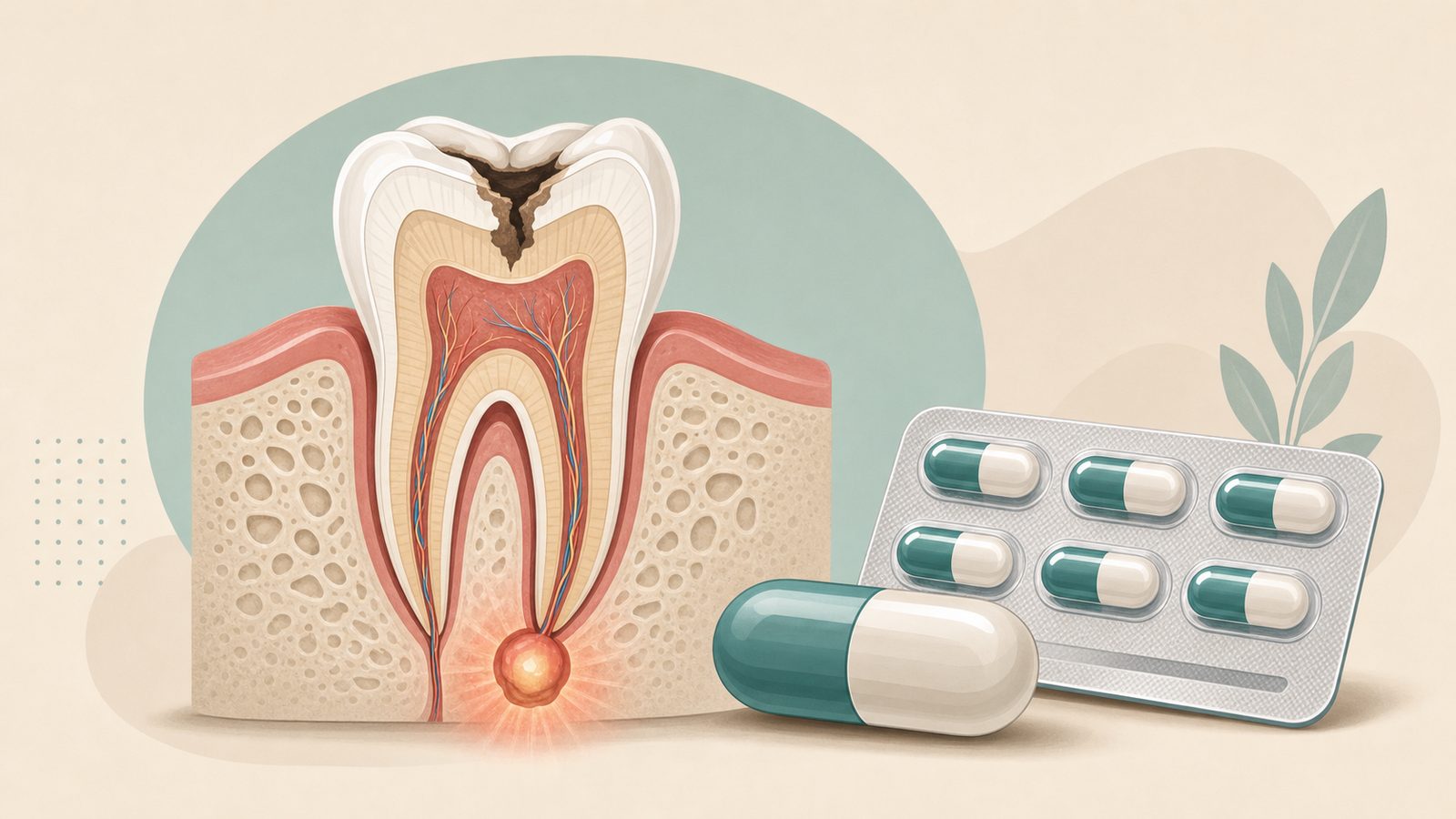
🗂 Key Takeaways
- The ADA 2019 guideline recommends against antibiotics for pulpal or periapical pain without systemic involvement in immunocompetent adults; drainage or endodontic therapy is the treatment.[1]
- Amoxicillin 500 mg PO every 8 hours for 3 to 7 days is first-line when antibiotics are indicated.[1]
- Amoxicillin-clavulanate 500/125 mg every 8 hours is preferred when the infection is severe or has failed amoxicillin monotherapy.[1]
- For severe penicillin allergy, the ADA guideline suggests azithromycin (500 mg on day 1, then 250 mg daily for 4 days) or clindamycin 300 mg every 6 hours; cephalexin is the suggested option for penicillin allergy without anaphylaxis, angioedema, or hives.[1]
- The Cochrane review found antibiotics alone do not meaningfully reduce pain from irreversible pulpitis; the tooth needs definitive treatment.[2]
- Roughly 30 to 80% of antibiotic prescriptions for dental visits in the US are considered unnecessary.[3]
- Fever, spreading facial swelling, floor-of-mouth swelling, difficulty swallowing or breathing, or vision change means the ER, not the dentist or a telehealth visit.[4]
When Antibiotics Are (and Are Not) Indicated
The 2019 American Dental Association (ADA) evidence-based clinical practice guideline by Lockhart and colleagues is the operative document in the United States. Its central conclusion, based on a systematic review, is that antibiotics for pulpal- and periapical-related dental pain and intraoral swelling should be prescribed only when there are systemic signs of infection.[1]
Systemic signs the guideline specifies include fever above 38°C (100.4°F), lymphadenopathy, extraoral swelling that crosses tissue planes, malaise, and trismus. The presence of any of these, combined with a clear dental source, is the threshold to prescribe. Everything below that threshold (localized pain, throbbing, sensitivity to hot or cold, a small localized swelling that can be drained) is a dental procedure problem, not an antibiotic problem.[1]
The reason for the restraint is not academic. Systemic antibiotics do not penetrate the pulp chamber or a walled-off periapical abscess well enough to sterilize the source. The 2019 Cochrane review by Agnihotry and colleagues found no clinically meaningful benefit for antibiotics in irreversible pulpitis.[2] The 2018 Cochrane review by Cope and colleagues on symptomatic apical periodontitis and acute apical abscess reached a similar conclusion: antibiotics as an adjunct to drainage or endodontic treatment did not consistently improve pain outcomes.[5]
First-Line: Amoxicillin
Amoxicillin is the first-line agent for a tooth infection with systemic signs in the ADA 2019 guideline for three reasons: it covers the mixed anaerobic-aerobic oral flora that dominate odontogenic infections, it penetrates well into abscessed tissue, and it has the best-tolerated side-effect profile among agents that work.[1]
Adult dose
Amoxicillin 500 mg by mouth every 8 hours for 3 to 7 days. A common alternative regimen is 1,000 mg every 12 hours, which some clinicians prefer for adherence. The 2018 Cope Cochrane review and the ESE 2018 position statement both support this general dose range.[5][6]
Why 3 to 7 days and not the classic 10
Ten-day courses were legacy practice, not evidence-based. The ADA 2019 guideline recommends the shortest effective duration and specifies 3 to 7 days once symptoms have resolved. In practice: reassess at day 3. If systemic signs are gone and the patient has a dental appointment scheduled, you can stop. If not, extend to day 7 while arranging definitive care.[1]
What to check before prescribing
Ask about penicillin allergy history and press for details (see the penicillin allergy section below). Ask about pregnancy (amoxicillin is category B and safe throughout pregnancy). Warn about diarrhea, rash, and the small but real risk of anaphylaxis. Amoxicillin does not interact with most common medications, but it can reduce the efficacy of oral contraceptives in some patients, so advise a backup method during the course and for 7 days afterward.
Amoxicillin-Clavulanate (Augmentin) for Severe Infection
Amoxicillin-clavulanate adds beta-lactamase coverage, which is useful when the infection has features that suggest resistant flora or when the patient has already had a failed amoxicillin course. Indications the ADA guideline and specialty consensus support include:[1][6]
- Extraoral swelling that has crossed a facial plane or is progressing
- Fever above 39°C (102.2°F) or worsening after 48 hours on amoxicillin
- Immunocompromised patients (diabetes with poor control, chemotherapy, HIV with CD4 <200, transplant recipients)
- Prior antibiotic exposure in the past 30 days
- Complicated dental history (implants, prior maxillofacial surgery)
Adult dose: amoxicillin-clavulanate 500/125 mg every 8 hours, or 875/125 mg every 12 hours, for 5 to 7 days. Warn patients about diarrhea, which is more common than with plain amoxicillin because of the clavulanic acid.[1]
Penicillin Allergy: Clindamycin and Alternatives
Penicillin allergy is the highest-yield conversation in dental prescribing. Roughly 10% of Americans carry a "penicillin allergy" label on their chart, but the best evidence suggests fewer than 1% have a true IgE-mediated allergy. The rest can safely take amoxicillin.[7]
The problem: when clinicians default to clindamycin because a chart says "penicillin allergy," they trade a beta-lactam with an anaphylaxis risk of <0.05% for a drug that is one of the most consistent triggers of Clostridioides difficile infection in dental practice.[7] Ask the following before jumping to clindamycin:
- What happened when you took penicillin or amoxicillin? A rash, hives, swelling of face or throat, trouble breathing, or anaphylaxis?
- When did this happen? Childhood reactions especially fade in adulthood.
- Have you tolerated a cephalosporin (like cephalexin) or amoxicillin since?
If the reported reaction was a low-severity rash more than 10 years ago and the patient has since tolerated a beta-lactam, amoxicillin is very likely safe. If the reaction was hives, angioedema, respiratory involvement, or anaphylaxis, do not rechallenge without allergy consultation and use a non-beta-lactam alternative.
Clindamycin (severe allergy option)
Clindamycin 300 mg by mouth every 6 hours for 3 to 7 days. Effective against the mixed anaerobic-aerobic oral flora. Warn patients about diarrhea and to stop clindamycin and call a clinician if diarrhea becomes severe, watery, or bloody, since C. difficile is the specific concern.[1][7]
Azithromycin (severe allergy option)
Azithromycin is the other ADA-suggested option for a documented severe penicillin allergy, and the natural choice when clindamycin is contraindicated (prior C. difficile, severe GI disease). Adult dose: 500 mg on day 1, then 250 mg once daily on days 2 to 5. Coverage of oral anaerobes is less consistent than clindamycin, so reassess earlier if the response is not brisk.[1]
A note on cephalexin
Some dental clinicians use cephalexin (a first-generation cephalosporin) for patients with a low-severity penicillin reaction because cross-reactivity between penicillins and cephalosporins is much lower than historically taught (probably around 1% for first-generation, and far less for later generations). Cephalexin 500 mg every 6 hours for 3 to 7 days is the option the ADA guideline suggests for penicillin allergy without a history of anaphylaxis, angioedema, or hives; it is not suggested for severe penicillin allergy.[1]
Dosing Comparison Table
| Drug | Adult dose | Duration | When to use | Cash cost, 5-day course |
|---|---|---|---|---|
| Amoxicillin | 500 mg PO q8h (or 1,000 mg q12h) | 3–7 days | First-line, no severe penicillin allergy | $4–$10 |
| Amoxicillin-clavulanate | 500/125 mg PO q8h (or 875/125 q12h) | 5–7 days | Severe infection, prior amox failure, immunocompromised | $12–$40 |
| Clindamycin | 300 mg PO q6h | 3–7 days | Severe penicillin allergy | $8–$25 |
| Azithromycin | 500 mg PO day 1, then 250 mg PO daily days 2–5 | 5 days | Severe penicillin allergy (preferred when clindamycin is contraindicated) | $8–$25 |
| Cephalexin | 500 mg PO q6h | 3–7 days | Non-severe penicillin allergy (some clinicians) | $4–$15 |
| Metronidazole (add-on) | 500 mg PO q8h with amoxicillin | 3–7 days | Severe or spreading anaerobic infection, in specialist care | $6–$18 |
Cash prices are typical US ranges for common generic retail and $4 discount pharmacy tiers as of 2026. Actual prices vary.
Duration: Why Shorter Is Now Preferred
Antimicrobial stewardship has driven duration down across every infection type in the last decade, and dental infections are no exception. The 2019 ADA guideline explicitly recommends short courses (3 to 7 days) once symptoms have resolved and the patient is being bridged to definitive dental treatment.[1]
The clinical rule of thumb: continue for 24 to 48 hours after the systemic signs (fever, extraoral swelling) resolve. If day 3 arrives and the patient is afebrile with resolving swelling, that is often enough. If they are not improving, the antibiotic is not the answer, drainage or a root canal is.[2][5]
If Antibiotics Are Not Working
A dental infection that has not responded in 48 to 72 hours needs re-evaluation, not a longer or stronger antibiotic. The three questions to ask:
- Is there an undrained abscess? A walled-off pus collection needs to be opened. Systemic antibiotics do not penetrate a mature abscess reliably.
- Was the antibiotic actually taken? Adherence, GI intolerance, and prescription-fill delays are common failure points.
- Is the infection now beyond the local space? Spread into deep neck spaces (submandibular, sublingual, parapharyngeal, retropharyngeal, masticator) is a surgical emergency, not a prescription refill.
Escalation options: switch amoxicillin to amoxicillin-clavulanate (or add metronidazole 500 mg every 8 hours to amoxicillin for anaerobic coverage) only if the patient has been seen and drainage or definitive treatment is now imminent. The correct next step for a patient who has failed a first antibiotic and cannot get dental care in 24 to 48 hours is often the emergency department, not another prescription.[4]
Pain Management: NSAIDs Beat Opioids
Antibiotics do not relieve dental pain quickly. Pain control between the prescription and the dental appointment matters, and the evidence is clear: a scheduled ibuprofen-acetaminophen combination is superior to opioids for acute dental pain, with far lower risk.[8]
The regimen with the strongest evidence for adult acute dental pain is ibuprofen 400 to 600 mg plus acetaminophen 500 mg, every 6 hours, alternated or given together, provided there are no contraindications (renal disease, active peptic ulcer, uncontrolled hypertension, pregnancy after 20 weeks for NSAIDs, hepatic disease for acetaminophen). This combination has been shown to outperform opioids in multiple randomized trials and to have a smaller number-needed-to-treat.[8]
Do not prescribe opioids as a first-line agent for acute dental pain. The 2020 Roberts JADA analysis of US emergency department dental visits from 2012 to 2014 found high rates of both opioid and antibiotic prescribing for dental-related presentations, most of which was not evidence-supported.[3]
Pain Regimen Comparison
| Regimen | Adult dose | NNT for 50% pain relief | Key harms |
|---|---|---|---|
| Ibuprofen + acetaminophen (first-line) | Ibuprofen 400 mg + acetaminophen 1,000 mg PO q6h | 1.5 | GI upset, renal effect with prolonged use |
| Ibuprofen alone | 400–600 mg PO q6h | 2.5 | Same as above |
| Naproxen | 500 mg PO q12h | 2.5 | Same as above, longer half-life |
| Acetaminophen alone | 1,000 mg PO q6h (max 3 g/day if hepatic risk) | 3.5 | Hepatotoxicity with overdose or chronic alcohol use |
| Oxycodone + acetaminophen (avoid first-line) | 5–10 mg oxycodone + 325 mg APAP q6h PRN | 3.3 | Sedation, dependence, nausea, respiratory depression |
| Codeine alone (avoid) | 60 mg PO q6h | 12 | Barely better than placebo, high nausea rate |
Effect sizes drawn from the Moore 2018 JADA overview of Cochrane reviews. The ibuprofen-acetaminophen combination is the highest-evidence, lowest-risk regimen for acute dental pain in adults.[8]
The Stewardship Problem
The 2024 Murphy and colleagues analysis in Infection Control and Hospital Epidemiology found that a large proportion of antibiotic prescriptions written at US dental visits in 2019 were not clinically indicated. Estimates from the broader literature put the share of unnecessary dental antibiotic prescriptions between 30% and 80% depending on the metric.[3]
Why this matters at the individual level, not just the population level: unnecessary antibiotic use shifts the gut microbiome, raises the risk of C. difficile infection (particularly with clindamycin), contributes to selection of resistant organisms, and offers no clinical benefit when the underlying problem is a diseased tooth. The most defensible prescribing pattern is a short course of amoxicillin for a clearly indicated infection, prompt dental follow-up, and no antibiotic at all for the many presentations where the answer is drainage, restoration, or extraction.[9]
Red Flags: When to Go to the ER
A tooth infection can become life-threatening. Go to the emergency department, not a dentist and not a telehealth visit, if any of the following are present:[4]
- Fever above 39°C (102.2°F) with rigors
- Rapidly progressing facial swelling, especially if it involves the eye or is on both sides of the neck
- Floor-of-mouth swelling with tongue elevation (Ludwig's angina risk)
- Difficulty swallowing, drooling that is new, or difficulty breathing
- Neck stiffness, torticollis, or trismus so severe you cannot open the mouth
- Vision change, eyelid swelling, or eye pain (orbital or cavernous sinus involvement risk)
- Confusion, severe malaise, or signs of sepsis
| Presentation | Right level of care | Why |
|---|---|---|
| Tooth pain, sensitive to cold, no swelling, no fever | Dentist within days | Reversible or irreversible pulpitis; needs restoration or root canal, not antibiotics |
| Localized tender gum swelling with a drainable head | Dentist same or next day | Localized periodontal or periapical abscess; drainage is the treatment |
| Fever 38.0 to 38.9 C, localized dental swelling, no red flags | Telehealth or in-person primary care, plus urgent dental follow-up | ADA 2019 threshold for empiric amoxicillin as a bridge |
| Facial swelling crossing tissue planes, worsening on antibiotics | Emergency department | Risk of deep space infection; may need IV antibiotics or surgical drainage |
| Floor-of-mouth swelling, dysphagia, drooling, dyspnea | Emergency department immediately | Ludwig's angina risk; airway is the primary concern |
| Vision change, eyelid swelling, severe headache | Emergency department immediately | Orbital cellulitis or cavernous sinus thrombosis risk |
Getting Antibiotics Online: When It Is Appropriate
A telehealth visit is appropriate for a dental infection when three things are true: a clear dental source, systemic signs that clearly cross the ADA 2019 prescribing threshold (fever, spreading swelling, malaise), and a dental appointment already scheduled within 24 to 72 hours. The role of the telehealth clinician is to bridge the gap between symptom onset and definitive dental care.
Telehealth is not appropriate when any red-flag feature is present, when there is no dental follow-up plan, when the patient has already had a failed antibiotic course, or when the presentation could plausibly be non-dental (sinusitis, salivary gland infection, TMJ disorder). In those cases the answer is in-person evaluation, not a virtual prescription.
Cash-pay economics: a telehealth visit for a clearly indicated dental infection is usually $35 to $75. Amoxicillin generic is $4 to $10 on discount pharmacy tiers. Total out-of-pocket for a straightforward cash visit plus antibiotics is typically $40 to $85, which is often less than an ED copay before insurance.
Bridge to Dental Care
Antibiotics buy time. The tooth still has to be treated. The three definitive options are root canal therapy, extraction, or, in rare cases where drainage alone is sufficient (a small periodontal abscess that has already opened), incision and drainage with periodontal follow-up. None of these is a physician's job. The role of a medical clinician here is to control systemic infection and pain in the interval before dental care and to know when the situation exceeds that role.
If you do not have a dentist, options include community dental clinics, dental schools, federally qualified health centers (which often have dental services on a sliding fee scale), and university-affiliated urgent dental services. Waiting for elective care while a dental infection recurs is how patients end up in the ED with Ludwig's angina.
Frequently Asked Questions
Most patients notice improvement in fever and swelling within 24 to 48 hours of the first dose. If there is no improvement by 72 hours, the antibiotic is not the fix, either the abscess needs drainage, the wrong drug was chosen, or the infection has spread beyond the local space. Reassess in person or in an ED.[1]
No. Amoxicillin controls the systemic spread of infection but cannot sterilize a diseased pulp or a walled-off abscess. Without a root canal, extraction, or drainage the infection typically returns after antibiotics are stopped, and each cycle is a chance for the infection to spread. The ADA 2019 guideline explicitly frames antibiotics as a bridge, not a cure.[1]
Amoxicillin 500 mg by mouth every 8 hours, or 1,000 mg every 12 hours, for 3 to 7 days. Duration should be the shortest that controls the systemic signs while you are being bridged to definitive dental care.[1]
Failure at 48 to 72 hours usually means there is an undrained abscess, not the wrong antibiotic. The right move is in-person evaluation for drainage or a root canal, not a stronger antibiotic on its own. If drainage is imminent, switching to amoxicillin-clavulanate or adding metronidazole is reasonable. If the infection is progressing with any red-flag feature, go to the ER.[1][5]
No. Amoxicillin remains the first-line agent per the ADA 2019 guideline. Clindamycin is reserved for severe penicillin allergy and carries a higher risk of C. difficile colitis than amoxicillin. Most patients labeled "penicillin allergic" are not truly allergic on formal testing and can safely take amoxicillin.[1][7]
No. The 2019 Cochrane review by Agnihotry and colleagues found no clinically meaningful benefit from antibiotics for irreversible pulpitis in immunocompetent adults without systemic signs. Definitive treatment is a root canal or extraction, and pain is best managed with a scheduled ibuprofen-acetaminophen combination.[2]
Amoxicillin is FDA category B and generally considered safe throughout pregnancy. Clindamycin is also generally safe (category B). Avoid tetracyclines (including doxycycline). Metronidazole is category B; some clinicians avoid it in the first trimester out of caution despite reassuring data. NSAIDs should be avoided after 20 weeks; acetaminophen is preferred for pain in the third trimester. Always talk to your obstetric clinician.
Not reliably. Symptoms can wax and wane, giving the impression the infection has resolved, but the underlying dead pulp or abscess remains and typically re-flares. Each recurrence is a chance for the infection to spread. The definitive treatment is dental (root canal or extraction).[1]
Yes, when the presentation is clear-cut: a dental source, systemic signs that meet the ADA prescribing threshold, no red-flag features, and a dental appointment already scheduled within 24 to 72 hours. A telehealth clinician can also confirm that antibiotics are not appropriate and steer you to the right care, which is often more valuable than the prescription itself.
Amoxicillin generic runs $4 to $10 for a 5-day course on major discount pharmacy tiers. Amoxicillin-clavulanate is $12 to $40. Clindamycin is $8 to $25. A cash-pay telehealth visit is typically $35 to $75. Total out-of-pocket for a straightforward case is usually $40 to $85.
Yes. Antibiotic response is not a cure. The tooth still has a diseased pulp or a periapical abscess that will re-flare. Book the dental appointment while the antibiotic is working; do not wait for the infection to come back.[1]
References
- Lockhart PB, Tampi MP, Abt E, et al. Evidence-based clinical practice guideline on antibiotic use for the urgent management of pulpal- and periapical-related dental pain and intraoral swelling: A report from the American Dental Association. Journal of the American Dental Association. 2019 Nov;150(11):906-921.e12. PMID: 31668170. https://pubmed.ncbi.nlm.nih.gov/31668170/
- Agnihotry A, Thompson W, Fedorowicz Z, van Zuuren EJ, Sprakel J. Antibiotic use for irreversible pulpitis. Cochrane Database of Systematic Reviews. 2019 May 30;5(5):CD004969. PMID: 31145805. https://pubmed.ncbi.nlm.nih.gov/31145805/
- Murphy AM, Patel UC, Wilson GM, Suda KJ. Prevalence of unnecessary antibiotic prescriptions among dental visits, 2019. Infection Control and Hospital Epidemiology. 2024 Jul;45(7):890-899. PMID: 38374683. https://pubmed.ncbi.nlm.nih.gov/38374683/
- Vieira F, Allen SM, Stocks RM, Thompson JW. Deep neck infection. Otolaryngologic Clinics of North America. 2008 Jun;41(3):459-483. PMID: 18435993. https://pubmed.ncbi.nlm.nih.gov/18435993/
- Cope AL, Francis N, Wood F, Chestnutt IG. Systemic antibiotics for symptomatic apical periodontitis and acute apical abscess in adults. Cochrane Database of Systematic Reviews. 2018 Sep 27;9(9):CD010136. PMID: 30259968. https://pubmed.ncbi.nlm.nih.gov/30259968/
- Segura-Egea JJ, Gould K, Şen BH, et al. European Society of Endodontology position statement: the use of antibiotics in endodontics. International Endodontic Journal. 2018 Jan;51(1):20-25. PMID: 28436043. https://pubmed.ncbi.nlm.nih.gov/28436043/
- Li S, Huang X, McNeil R, Malmstrom H, Ren Y. Systemic health implications of dental prescribing in general practices. Quintessence International. 2026 Feb;57(2):1-15. https://www.quintessence-publishing.com/deu/en/journal/qi
- Moore PA, Ziegler KM, Lipman RD, Aminoshariae A, Carrasco-Labra A, Mariotti A. Benefits and harms associated with analgesic medications used in the management of acute dental pain: An overview of systematic reviews. Journal of the American Dental Association. 2018 Apr;149(4):256-265.e3. PMID: 29599019. https://pubmed.ncbi.nlm.nih.gov/29599019/
- Roberts RM, Bohm MK, Bartoces MG, Fleming-Dutra KE, Hicks LA, Chalmers NI. Antibiotic and opioid prescribing for dental-related conditions in emergency departments: United States, 2012 through 2014. Journal of the American Dental Association. 2020 Mar;151(3):174-181.e1. PMID: 31959329. https://pubmed.ncbi.nlm.nih.gov/31959329/
About the Author
Parth Bhavsar, MD is a board-certified family medicine physician and the founder of TeleDirectMD, a physician-only virtual urgent care platform. He reviews every guide in this library. NPI 1104323203.