Key Takeaways
- Hemorrhoids are normal veins and vascular cushions in and around the anus that become swollen and symptomatic; internal hemorrhoids usually bleed painlessly, while external hemorrhoids itch, hurt, or form a tender lump.[2][11]
- Rectal bleeding is a symptom, not a diagnosis. It can also signal inflammatory bowel disease or colorectal cancer, so new or recurrent bleeding warrants evaluation.[2][1]
- The main causes are straining, constipation, a low-fiber diet, prolonged toilet sitting, and increased pressure in the abdomen, including from pregnancy.[11][5]
- Fiber (about 25 to 30 g daily), fluids, and better bowel habits are the first-line treatment, and the 2024 ASCRS guideline gives this a strong recommendation.[1][11]
- Warm sitz baths and short-term over-the-counter products relieve symptoms but do not remove hemorrhoids.[3][10]
- Rubber band ligation is the most effective office procedure; surgery is reserved for external or combined internal and external disease (grades III-IV).[1]
- Hemorrhoids are common in pregnancy and usually resolve after delivery; treatment in pregnancy is nonoperative (fiber, fluids, limited topicals).[11][12]
What Are Hemorrhoids?
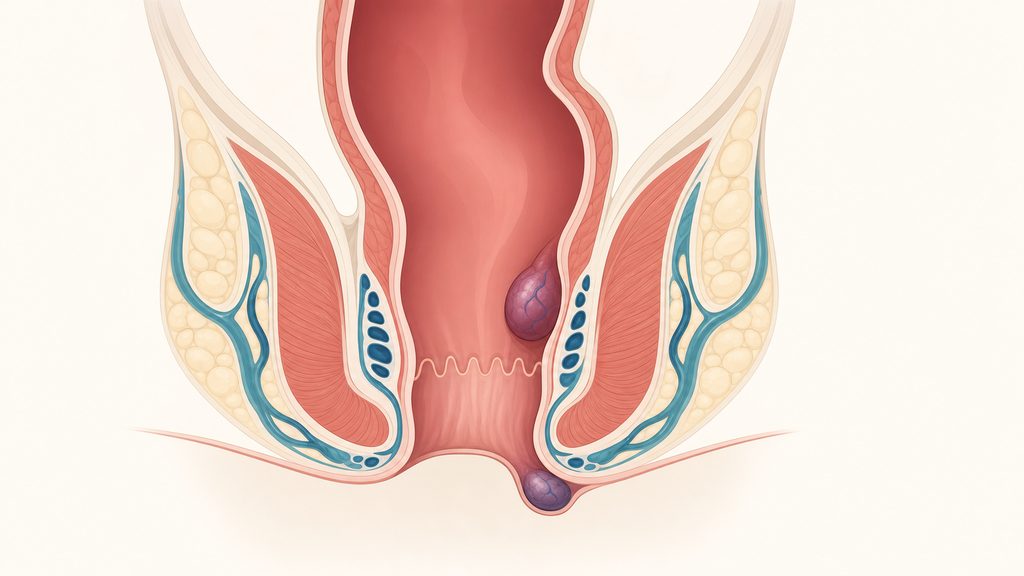
Hemorrhoids, also called piles, are swollen veins and vascular cushions in the lower rectum and around the anus. The cushions themselves are normal anatomy; they only cause symptoms when they enlarge and protrude.[11] They are classified by their location relative to the dentate line, the boundary inside the anal canal that separates sensitive skin from insensitive lining.[10][11]
Internal hemorrhoids form above the dentate line, inside the rectum, where there are no pain-sensing nerves. They are usually painless and present either as bright-red bleeding or as prolapse, when the hemorrhoid slides down through the anal opening.[2][10] External hemorrhoids form below the dentate line, under the skin around the anus, where there are pain-sensing nerves. They cause itching, tenderness, a lump, and pain, especially when sitting.[2][11]
Symptoms: What Hemorrhoids Look and Feel Like
People with symptomatic hemorrhoids most often report rectal bleeding, itching, or both. In a clinical review, roughly 60 percent report bleeding, 55 percent report itching, about 20 percent report perianal discomfort, and about 10 percent report soiling.[10] The specific picture depends on whether the hemorrhoid is internal or external.
Internal hemorrhoids
- Painless bright-red blood on stool, on toilet paper, or in the toilet bowl after a bowel movement.[2]
- A feeling of fullness, pressure, or incomplete emptying, sometimes with mucus or itching.[2]
- Prolapse: a soft, moist lump that appears at the anal opening, especially during a bowel movement, and may go back on its own or need to be pushed back.[2][10]
Because the lining of the rectum does not have pain nerves, a non-prolapsed internal hemorrhoid is typically not painful, and you usually cannot see it without an examination.[10]
External hemorrhoids
- One or more hard or tender lumps near the anus.[2]
- Anal itching and irritation.[2]
- An ache or pain, especially when sitting or cleaning.[2]
A thrombosed external hemorrhoid is a blood clot inside an external hemorrhoid. It appears suddenly as a firm, very tender, bluish or purple lump at the anal margin, often after straining or vigorous activity, and it is painful.[10][11] Too much straining, rubbing, or aggressive cleaning can make any of these symptoms worse.[2]
What Causes Hemorrhoids?
Hemorrhoids develop when pressure in and around the anal canal increases, causing the veins to swell and the supporting tissue to weaken.[11] The most common contributors are:
- Straining during bowel movements, which raises pressure inside the abdomen.[5][11]
- Constipation and hard stools, the single most important risk factor; a low-fiber diet is a key driver.[11][2]
- Chronic diarrhea, which also irritates the anal area.[2]
- Sitting on the toilet for long periods.[5]
- Pregnancy, from hormonal changes, constipation, and the growing uterus raising abdominal pressure.[11]
- Heavy lifting and other activities that repeatedly increase abdominal pressure.[2][11]
- Aging, as the connective tissue that supports the cushions weakens over time.[2]
- Obesity and a larger waist circumference.[12]
These are risk factors, not guarantees. Many people have hemorrhoids without symptoms, and several of these factors usually act together rather than any single one causing the problem on its own.[10]
When to Seek Care vs. Treat at Home
Get evaluated promptly, or seek emergency care
- Heavy or continuous rectal bleeding, especially with lightheadedness, weakness, or fainting.
- Black, tarry stool, which can mean bleeding higher in the digestive tract.
- Severe or escalating pain.
- Fever with anorectal pain or swelling.
- Inability to pass stool or gas together with significant abdominal symptoms.
- A hard, new or worsening, very tender lump at the anus (possible thrombosed external hemorrhoid).
Schedule an assessment if you have
- A first episode of rectal bleeding, at any age.
- Bleeding that recurs, even if it seems minor.
- Symptoms not improved after about one week of at-home care.
- Unintentional weight loss or symptoms of anemia such as persistent fatigue or shortness of breath.
- A change in bowel habits, or a personal or family history of colorectal cancer or polyps.
The reason these flags matter is that the 2024 ASCRS guideline recommends complete endoscopic evaluation of the colon in select people with symptomatic hemorrhoids and rectal bleeding, and NIDDK is explicit that rectal bleeding may signal Crohn's disease, ulcerative colitis, or colorectal cancer.[1][2] Do not assume a painful anal lump is a hemorrhoid, and do not assume bleeding is harmless. For uncomplicated symptoms with no bleeding and no red-flag features, conservative care at home is the appropriate starting point.[1]
If you want a video consultation for hemorrhoid symptoms rather than in-person care, TeleDirectMD offers online hemorrhoid evaluation at its hemorrhoid treatment page.
Diet and Lifestyle: Fiber
Fiber softens stool and reduces straining, which directly lowers hemorrhoid symptoms and bleeding. In a Cochrane review underpinning the ASCRS recommendation, fiber supplementation reduced the risk of persistent or non-improving symptoms by about half (relative risk 0.53) and reduced bleeding (relative risk 0.50).[1] Clinical guidance recommends about 25 to 30 grams of fiber a day, and NIDDK points to the Dietary Guidelines figure of 14 grams per 1,000 calories, about 28 grams on a 2,000-calorie diet.[11][4] Increase fiber gradually over a week or two to limit bloating and gas.
| Food (portion) | Fiber |
|---|---|
| 1/2 cup high-fiber bran cereal | 14.0 g |
| 1/2 cup navy beans, cooked | 9.6 g |
| 1 cup green peas, cooked | 8.8 g |
| 1 cup raspberries | 8.0 g |
| 1/2 cup pinto beans, cooked | 7.7 g |
| 1 medium pear, with skin | 5.5 g |
| 1 medium apple, with skin | 4.8 g |
| 1/4 cup prunes | 3.1 g |
If diet alone is not enough, a fiber supplement such as psyllium (Metamucil) or methylcellulose (Citrucel) can help.[3]
Diet and Lifestyle: Fluids and Bathroom Habits
Water and fluids
Fiber works only with enough fluid. Drink water or other nonalcoholic liquids each day so stools stay soft and easy to pass. Water, fruit juices, and clear soups help fiber work better, and the right daily amount depends on your health, activity level, and climate.[3][4]
Bathroom habits
Four habits carry most of the benefit: do not strain during bowel movements, do not sit on the toilet for long periods, go when you feel the urge and leave when you are done, and avoid regular heavy lifting.[3][5] Avoid bringing a phone or reading material into the bathroom.
Sitz Baths
A sitz bath is a shallow bath of warm water covering only the hips and buttocks. It can relieve itching, irritation, and soreness around the anus, and clinical guidance lists warm sitz baths as a reasonable comfort measure for local symptoms.[3][10]
- How: fill a clean basin or tub with a few inches of warm, not hot, water, and sit for about 15 to 20 minutes.
- How often: two to three times a day, and after bowel movements.
- Afterwards: pat the area dry gently rather than rubbing.
A sitz bath soothes symptoms; it does not shrink or remove hemorrhoids. If the water is too hot, or if you add soap, salts, or other products, you can irritate the skin further. Keep it to plain warm water unless a clinician tells you otherwise.[3]
Over-the-Counter Products and Their Limits
The single most important rule comes from NIDDK: most often, doctors recommend using over-the-counter hemorrhoid products for about one week. If a product does not relieve symptoms after one week, or causes side effects such as dry skin around the anus or a rash, stop and contact a doctor.[3] Over-the-counter creams fall into a few ingredient types that each work differently: hydrocortisone reduces inflammation and itching, phenylephrine temporarily shrinks swollen tissue, pramoxine numbs surface pain, and witch hazel acts as an astringent to soothe irritation.[6][8][9] Select each product to see its dose and limit.
Use: cleanse gently, pat dry, then apply externally up to 6 times daily or after each bowel movement. Limit: external use only; discard after a single use and do not flush.[9]
Use: apply externally or in the lower portion of the anal canal only, up to 4 times daily (morning, night, or after each bowel movement). Limit: no more than 4 times daily; continuous use should generally not exceed about 7 days.[8]
Use: apply to the affected area not more than 3 to 4 times daily after cleansing and gently patting dry. Limit: stop and ask a doctor if symptoms persist more than 7 days; do not use for longer than 7 days unless directed. External use only, do not apply inside the rectum with a finger or applicator.[6]
Use: 1 to 3 softgels daily for adults and children 12 and older, taken with water; usually produces a bowel movement within 12 to 72 hours. Limit: do not use as a laxative for more than one week unless directed. Stop and ask a doctor if you have rectal bleeding or no bowel movement after use.[7]
NIDDK also notes that over-the-counter pain relievers such as acetaminophen, ibuprofen, naproxen, or aspirin may be used for discomfort.[3] Aspirin and nonsteroidal anti-inflammatory drugs can worsen bleeding, so if you have active rectal bleeding, ask a clinician before taking them. None of these topicals cure hemorrhoids; they reduce symptoms while fiber, fluids, and bowel habits address the cause.
Office Procedures vs. Surgery
The 2024 ASCRS guideline separates office-based procedures, appropriate for most symptomatic grade I-II internal hemorrhoids and selected grade III disease, from surgery for external hemorrhoids or combined internal plus external disease (grades III-IV).[1] The table below summarizes how the options compare.
| Factor | Rubber band ligation | Sclerotherapy | Infrared coagulation (IRC) | Excisional hemorrhoidectomy |
|---|---|---|---|---|
| Setting | Office | Office | Office | Operating room (anesthesia) |
| Best for | Grade I-III internal | Grade I-II internal | Grade I-II internal | External, or combined internal and external grade III-IV |
| How it works | Band cuts off blood supply; tissue shrivels and falls off, most often within a week | Injected solution forms scar tissue that cuts off blood supply | Infrared heat forms scar tissue that cuts off blood supply | Tissue surgically removed |
| Effectiveness | Most effective office procedure | Less effective than banding | Less effective than banding | Most effective overall; highest single-procedure success |
| Pain | More than sclerotherapy or IRC, less than surgery | Low | Low | Highest; longest recovery |
| Repeat needs | Often more than one session | May require repeats | May require repeats | Usually a single treatment |
A meta-analysis of 18 randomized studies found rubber band ligation superior to sclerotherapy and infrared coagulation for grades I, II, and III disease in terms of needing fewer repeat treatments, though with somewhat more pain and a small complication risk. Compared with surgery, ligation is less effective for grade III disease and more likely to require multiple procedures, but it carries less pain and fewer complications.[1] Excisional hemorrhoidectomy is the most definitive option and is reserved for when office procedures fail or are not suitable, and the ASCRS gives this a strong recommendation based on high-quality evidence.[1]
Thrombosed External Hemorrhoid
A thrombosed external hemorrhoid is a painful blood clot in an external hemorrhoid. The 2024 ASCRS guideline says select patients may benefit from early surgical excision.[1] Timing matters: excision is generally not recommended once more than about 72 hours have passed since the pain began, because the discomfort from thrombosis usually resolves on its own within 7 to 10 days.[10] New, severe, localized anal pain with a tender lump warrants prompt evaluation, because the window for the most effective intervention is short.
Hemorrhoids in Women and Pregnancy
Hemorrhoids are common in women, and pregnancy is a well-recognized trigger because hormonal changes, pregnancy-related constipation, and the growing uterus all raise pressure in the anal area.[11] Most women with hemorrhoids in pregnancy can be managed without procedures; a large nationwide cohort found that 93 percent of pregnant women treated for hemorrhoids used a topical ointment, about 31 percent received an oral medication, and only about 1.8 percent required a procedure or surgery.[12] The risk is higher in women with a prior history of hemorrhoids and in multifetal (twin or higher) pregnancies.[12]
During pregnancy, treatment should stay nonoperative: a nonoperative approach with fiber, fluids, stool management, and limited topical treatments is recommended.[11] Many hemorrhoidal symptoms that begin during pregnancy improve or resolve on their own after delivery.[11] If you are pregnant or postpartum and have rectal bleeding, a painful lump, or symptoms that are not improving, discuss it with your obstetric or primary care clinician, because bleeding in pregnancy can have causes other than hemorrhoids.[11]
Prevention
Most hemorrhoid symptoms can be reduced by keeping stools soft and taking pressure off the anal area. The essentials are: eat about 25 to 30 grams of fiber a day with enough water, avoid straining and long periods on the toilet, respond promptly to the urge to go, and stay physically active.[1][11] These habits treat mild symptoms and help prevent recurrences after more involved treatment.
Frequently Asked Questions
External hemorrhoids look like a small lump or swelling around the anal opening, and can be hard and tender. Internal hemorrhoids are usually not visible without an examination; instead they cause painless bleeding or a soft, moist lump that appears briefly during a bowel movement. A thrombosed external hemorrhoid looks like a firm, bluish or purple, very tender lump.[2][10]
Yes. Internal hemorrhoids commonly cause painless bright-red blood on stool, on toilet paper, or in the toilet bowl. But bleeding should not be assumed to be from hemorrhoids, because it can signal other conditions, so new or recurrent bleeding warrants evaluation.[2]
Often yes. Mild symptoms and prolapsed internal hemorrhoids frequently improve with conservative measures such as increased fiber and fluid, not straining, and limiting time on the toilet. The underlying tendency can recur, which is why fiber, fluids, and bowel-habit changes are the foundation of prevention.[2]
A sitz bath is a shallow soak in plain warm water and helps relieve itching, soreness, and irritation around the anus. Soak for about 15 to 20 minutes, two to three times a day, and pat dry afterward. It soothes symptoms but does not remove hemorrhoids.[3]
Heavy or continuous bleeding, fainting or lightheadedness, black tarry stool, severe escalating pain, fever, or inability to pass stool or gas with significant abdominal symptoms all warrant urgent or emergency evaluation.
Yes, for uncomplicated symptoms. Increase fiber and fluids, avoid straining and prolonged sitting on the toilet, use warm sitz baths for comfort, and use over-the-counter products only within their labeled limits and for about one week. If symptoms are not better within a week, or if you have any rectal bleeding, see a clinician.[3]
Often, yes. Many hemorrhoidal symptoms that develop during pregnancy improve or resolve after delivery. Treatment during pregnancy stays nonoperative: fiber, fluids, and limited topical products. If you are pregnant with persistent bleeding or pain, speak with your obstetric or primary care clinician.[11]
References
- Hawkins AT, Davis BR, Bhama AR, Fang SH, Dawes AJ, Feingold DL, Lightner AL, Paquette IM; Clinical Practice Guidelines Committee of the American Society of Colon and Rectal Surgeons. The American Society of Colon and Rectal Surgeons Clinical Practice Guidelines for the Management of Hemorrhoids. Dis Colon Rectum. 2024;67(5):614-623. doi:10.1097/DCR.0000000000003276. PMID: 38294832. https://pubmed.ncbi.nlm.nih.gov/38294832/
- National Institute of Diabetes and Digestive and Kidney Diseases (NIDDK). Symptoms & Causes of Hemorrhoids. https://www.niddk.nih.gov/health-information/digestive-diseases/hemorrhoids/symptoms-causes
- National Institute of Diabetes and Digestive and Kidney Diseases (NIDDK). Treatment of Hemorrhoids. https://www.niddk.nih.gov/health-information/digestive-diseases/hemorrhoids/treatment
- National Institute of Diabetes and Digestive and Kidney Diseases (NIDDK). Eating, Diet, & Nutrition for Hemorrhoids. https://www.niddk.nih.gov/health-information/digestive-diseases/hemorrhoids/eating-diet-nutrition
- National Institute of Diabetes and Digestive and Kidney Diseases (NIDDK). Definition & Facts of Hemorrhoids. https://www.niddk.nih.gov/health-information/digestive-diseases/hemorrhoids/definition-facts
- DailyMed. Hydrocortisone 1% cream drug label (directions and 7-day use limit). https://dailymed.nlm.nih.gov/dailymed/lookup.cfm?setid=0f4ede34-7e70-789e-e063-6394a90a72a4
- DailyMed. Docusate sodium softgel drug label (directions and one-week limit). https://dailymed.nlm.nih.gov/dailymed/fda/fdaDrugXsl.cfm?setid=cc8d1556-f108-4166-837c-48f81152877e
- Preparation H. Rapid Relief Hemorrhoidal Cream directions (phenylephrine HCl 0.25%). https://www.preparationh.com/content/dam/cf-consumer-healthcare/bp-preparationh/en_US/pdfs/preparation-h-rapid-relief-hemorrhoidal-cream.pdf
- Tucks. Medicated Cooling Pads directions (witch hazel, up to 6 times daily). https://tucks.com/product/tucks-medicated-cooling-pads/
- Jacobs D. Clinical practice: Hemorrhoids. N Engl J Med. 2014;371(10):944-951. doi:10.1056/NEJMcp1204188. PMID: 25184866. https://pubmed.ncbi.nlm.nih.gov/25184866/
- BMJ Best Practice. Hemorrhoids. https://bestpractice.bmj.com/topics/en-us/181
- Chen YY, Chang CY, Lin CH, Cheng LY, Shih WT, et al. Prevalence, characteristics, and treatment of hemorrhoids during pregnancy: A nationwide population-based cohort study in Taiwan. J Womens Health (Larchmt). 2023. https://openurl.ebsco.com/contentitem/lgd:174017006