Key Takeaways
- Recurrent intraoral herpes sores typically appear on the gums and hard palate (firmly attached tissue), unlike canker sores, which favor the inner lip and cheek.[1][2]
- Primary infection in children, herpetic gingivostomatitis, causes fever and painful sores throughout the mouth, gums, and lips and usually lasts 10 to 14 days.[1][5]
- Canker sores (aphthous ulcers) are not caused by HSV, are not contagious, and do not respond to antiviral medication.[1][4]
- Sores on the inner lip or cheek that are single, round, and pale are far more likely canker sores than herpes.[1]
- Intraoral herpes is contagious, especially during the blistering and weeping phases, so avoid kissing and sharing utensils during an active outbreak.[7][8]
- A first, severe, or persistent mouth infection, or one in an infant or immunocompromised person, warrants a clinician evaluation.[7][1]
Cold Sores vs Intraoral Herpes
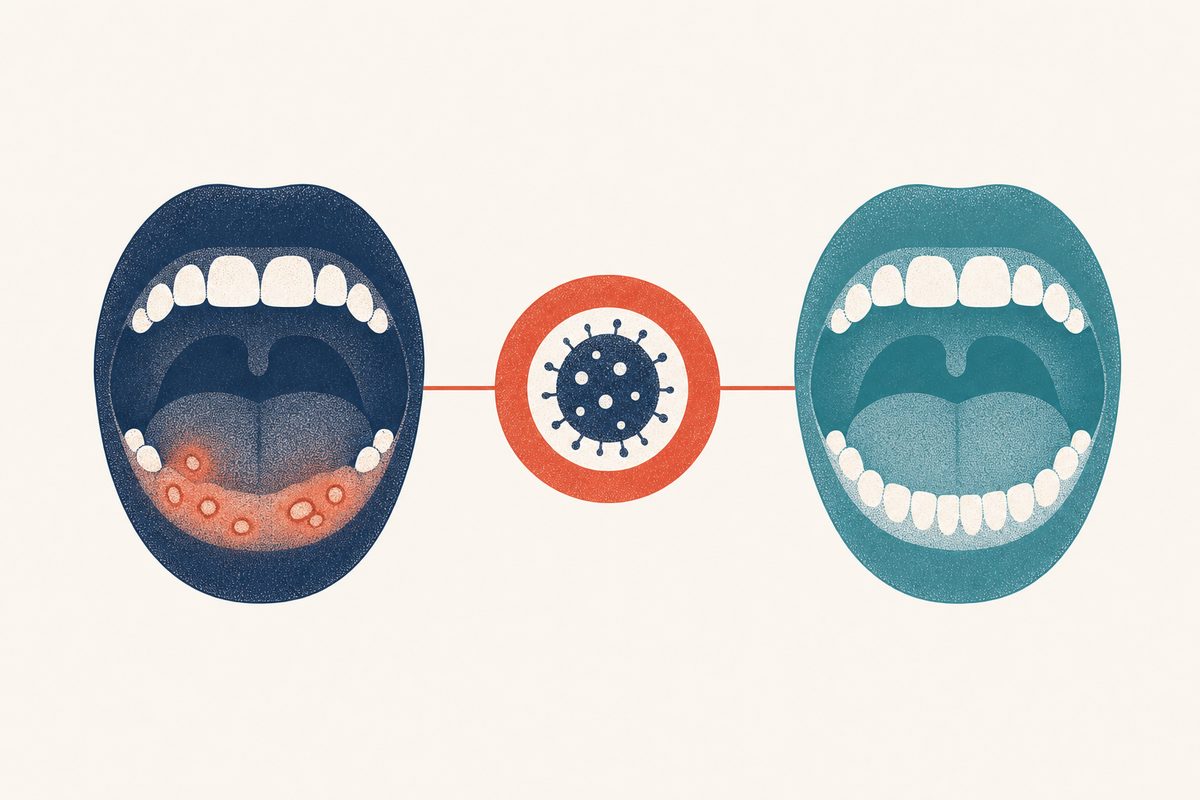
People commonly equate "cold sore" with the lip, but the same virus can also cause sores inside the mouth. The classic cold sore appears on the outer lip and surrounding skin, while an intraoral herpes sore occurs on the lining of the mouth itself. Both are caused by herpes simplex virus, almost always HSV-1.[1][8]
There is a useful anatomical pattern that helps clinicians tell intraoral herpes from other mouth sores. Herpes simplex has a predilection for firmly attached mucosa, the gums (gingiva) and the roof of the mouth (hard palate). Canker sores, by contrast, favor the loose, non-keratinized lining, most often the inner cheek and inner lip. A recurrent sore on the gum or hard palate is therefore more suggestive of herpes, while a sore on the inner lip or cheek points toward aphthous (canker) ulcer.[1][2]
Intraoral herpes blisters are small and fragile, and inside the moist mouth they typically rupture quickly, leaving shallow, painful ulcers that may merge. Because the blisters break so fast in the mouth, patients and clinicians often see the ulcer stage rather than intact blisters, which is one reason the diagnosis can be missed.[1][3]
Primary Gingivostomatitis in Children
When a child is first infected with HSV-1, usually in the toddler through early school-age years, the result is often a distinctive and uncomfortable syndrome called primary herpetic gingivostomatitis. Rather than a single lip sore, the first infection can cause widespread inflammation of the gums and lining of the mouth with numerous painful sores.[1][5]
The typical picture includes fever, irritability, swollen and bleeding gums, drooling, and refusal to eat or drink because the mouth hurts. The illness generally runs about 10 to 14 days. Dehydration from not drinking is the most common serious concern, so encouraging fluids is a priority.[1][5]
Because this is a first infection, the child has no prior immunity, which is why it is more dramatic than a routine recurrence. Older children, teens, and adults who were never infected in childhood can also develop primary gingivostomatitis, though it is most common in young children.[1] Later, after the initial infection resolves, any future outbreaks are the more limited, recurrent form.[1][8]
Herpes Sore vs Canker Sore
This is the most common diagnostic question for mouth sores, and the distinction matters because the treatment is different.
- Herpes sore: caused by HSV-1; contagious; often preceded by a tingling or burning; forms fragile blisters that ulcerate; typically on the gums or hard palate; responds to antiviral medication.[1][2]
- Canker sore (aphthous ulcer): not caused by a virus; not contagious; appears as a single, round or oval, shallow, pale ulcer with a red rim; usually on the inner lip, inner cheek, or under the tongue; managed symptomatically, since antivirals do not help.[1][4]
Canker sores are extremely common, and the majority of white, painful ulcers on the inner lip or cheek are canker sores rather than herpes. They can be triggered by minor injury, stress, certain foods, or appear without an obvious cause. Because they are not infections, they do not spread to others and do not need antiviral treatment.[1][4]
A third category is trauma, a bite to the inside of the cheek or a burn, which produces a sore at the exact site of injury. And there are less common causes of mouth ulcers that a clinician may need to consider, especially for ulcers that persist beyond two weeks without healing.[3][1]
| Feature | Herpes sore | Canker sore | Traumatic ulcer |
|---|---|---|---|
| Cause | HSV virus[2] | Not viral; immune/injury related[1] | Bite or burn[3] |
| Typical site | Gums, hard palate[1] | Inner lip, inner cheek[1] | Exact site of injury |
| Early feeling | Tingling or burning[2] | Usually none | Sudden pain at injury |
| Contagious | Yes[7] | No[4] | No |
| Treatment | Antiviral, early[6] | Symptom care[4] | Protect and heal |
Recurrent Intraoral Herpes in Adults
In adults, recurrent herpes can occasionally appear inside the mouth rather than on the lip. A case series of 58 otherwise healthy adults with recurrent intraoral HSV-1 documented the typical features: painful sores, often on the gums and palate, usually self-limiting, and frequently preceded by prodromal tingling.[2] These episodes are usually shorter and less dramatic than a primary infection.
Recurrent intraoral herpes tends to run a course measured in about a week to two weeks, with the worst pain during the ulceration phase. The same triggers that provoke lip cold sores, sun, stress, illness, and trauma, can provoke intraoral recurrences, and the same early-treatment principle applies.[1][9]
Some people with recurrent intraoral herpes mistake their outbreaks for recurring canker sores. If sores recur frequently in the same attachment-site location, are preceded by tingling, or are accompanied by a lip cold sore at the same time, herpes is more likely, and antiviral treatment may be worth discussing with a clinician.[2][1]
| Feature | Primary infection (gingivostomatitis) | Recurrent intraoral herpes |
|---|---|---|
| Who | Usually young children at first exposure[1] | Adults with dormant virus[2] |
| Symptoms | Fever, widespread mouth and gum sores[5] | Localized, painful, often on gums/palate[2] |
| Duration | About 10 to 14 days[1] | About one to two weeks[2] |
| Recurs | One-time first event, then recurrences possible[1] | Yes, in response to triggers[1] |
Treatment for Inside-the-Mouth Sores
Treatment depends on which kind of sore you have.
For intraoral herpes, oral antiviral medication (acyclovir, valacyclovir, or famciclovir) is the evidence-based treatment, and it is most effective when started early. In primary gingivostomatitis, oral acyclovir is commonly prescribed, particularly for children, to reduce the severity and duration of the illness when given early enough.[1][6] Pain relief with acetaminophen or ibuprofen and maintaining fluids are important supportive measures, especially in children.[1][5]
For canker sores, antivirals do not help, because there is no virus to treat. Management is symptomatic: avoiding irritating or acidic foods, using a topical numbing or protective product, and in more bothersome or recurrent cases, prescription options that a clinician can discuss.[1][4]
| Condition | Cause | Contagious? | Treatment |
|---|---|---|---|
| Intraoral herpes | HSV-1 virus[2] | Yes[7] | Oral antiviral, early[6] |
| Herpetic gingivostomatitis | Primary HSV-1 infection[1] | Yes[7] | Antiviral, fluids, pain relief[1] |
| Canker sore | Not viral; immune/injury related[1] | No[4] | Symptom care, no antivirals[4] |
| Traumatic ulcer | Bite or burn[3] | No | Protect the area; allow healing |
Contagiousness and Spread
Intraoral herpes, like lip cold sores, is contagious, especially during the blistering and weeping phases when the sores and saliva carry live virus. HSV-1 spreads through saliva and direct contact, so during an active outbreak it is important to avoid kissing, sharing cups, utensils, and toothbrushes, and to wash hands after touching the mouth.[7][8]
This matters most for infants and people with weakened immune systems. Newborns can develop serious, sometimes life-threatening HSV infection, so anyone with an active cold sore, whether on the lip or in the mouth, should avoid close contact with a baby.[7][8]
Canker sores and traumatic ulcers are not contagious and require no special precautions to protect others.[4][1]
When to See a Clinician
Many mouth sores are self-limiting, but several situations warrant evaluation:
- A first HSV infection with high fever, refusal to drink, or signs of dehydration, especially in a young child.[1][5]
- An ulcer that has not healed within about two weeks, or that keeps recurring.[1]
- Sores in someone who is immunocompromised, which can be larger, deeper, and more persistent.[7][1]
- Very large, very painful, or multiple sores, or an accompanying lip cold sore with eye symptoms.[4]
- Uncertainty about the diagnosis, since some uncommon but important conditions can present as a mouth ulcer.[3][1]
A clinician can distinguish these patterns on examination and prescribe the appropriate treatment, including antivirals for confirmed or likely herpes and symptomatic care otherwise.[6][1]
Frequently Asked Questions
References
- Woo SB, Challacombe SJ. Management of recurrent oral herpes simplex infections Oral Surgery, Oral Medicine, Oral Pathology, Oral Radiology, and Endodontology. 2007;103(Suppl):S12.e1-18.. doi:10.1016/j.tripleo.2006.11.004
- Tovaru S, Parlatescu I, Tovaru M, Cionca L, Arduino PG. Recurrent intraoral HSV-1 infection: a retrospective study of 58 immunocompetent patients from Eastern Europe Medicina Oral, Patología Oral y Cirugía Bucal. 2011;16(2):e163-169.. doi:10.4317/medoral.16.e163
- de Paiva JPG, Sousa-Neto SS, Humberto MAC, Magalhães MAO, Bubola J, Assunção Júnior JNR, et al. Unusual oral presentations of herpes simplex virus-1: a series of eight cases and literature review Special Care in Dentistry. 2025;45(2):e70129.. doi:10.1111/scd.70129
- Opstelten W, Neven AK, Eekhof J. Treatment and prevention of herpes labialis Canadian Family Physician. 2008;54(12):1683-1687.. PMID 19074705
- Leung AKC, Barankin B. Herpes labialis: an update Recent Patents on Inflammation & Allergy Drug Discovery. 2017;11(2):107-113.. doi:10.2174/1872213X11666171003151717
- Cernik C, Gallina K, Brodell RT. The treatment of herpes simplex infections: an evidence-based review Archives of Internal Medicine. 2008;168(11):1137-1144.. doi:10.1001/archinte.168.11.1137
- Centers for Disease Control and Prevention. Herpes: STI treatment guidelines, 2021 CDC Division of STD Prevention.. cdc.gov herpes treatment guidelines
- World Health Organization. Herpes simplex virus fact sheet WHO. Updated May 30, 2025.. who.int herpes fact sheet
- Spruance SL, Jones TM, Blatter MM, Vargas-Cortes M, Barber J, Hill J, et al. High-dose, short-duration, early valacyclovir therapy for episodic treatment of cold sores: results of two randomized, placebo-controlled, multicenter studies Antimicrobial Agents and Chemotherapy. 2003;47(3):1072-1080.. doi:10.1128/AAC.47.3.1072-1080.2003